
Why Speech Language Pathologists Should Rent Furnished Offices
Unlike other solo entrepreneurs who can hang their shingle at any local Louisville coffee shop or out of their house, as health professionals we don’t have that same luxury. In order to abide by HIPAA and/or maintain confidentiality for our clients we have to have a private, safe and neutral space to meet with them in. This barrier can add a lot of additional costs and stress onto our plates, which quite honestly turns away a lot of clinicians from getting into private practice in the first place.
Unlike other solo entrepreneurs who can hang their shingle at any local Louisville coffee shop or out of their house, as speech and language health care professionals we don’t have that same luxury. In order to abide by HIPAA and maintain confidentiality for our clients we have to have a private, safe and neutral space to meet with them in. This barrier can add a lot of additional costs and stress onto our plates. Unfortunately, this fact quite honestly turns away a lot of clinicians from getting into private practice in the first place which is why therapists and other mental health professionals should rent furnished offices!
Going through the office hunt process = headache
Signing a long-term commercial lease (2-5 years on average) = Yikes! Most of us don’t have clients when we are first opening up shop (therefore no income), so committing to a lease for that long can be hard to wrap your head around
Furnishing said office = $$$
Upkeeping said office = Décor, cleaning, trash, restocking supplies, paying bills, etc.
Why Speech Language Pathologists Should Rent Furnished Offices
Ease
Instead of having to worry about all the items listed above, you can spend more time focusing on your clients. All you have to do is start your practice, market your services, come in, do your work and leave because the rest will be taken care of for you :)
Low startup costs
If you aren’t having to put down a hefty security deposit, and furnish an office and waiting area, your startup costs are going to be drastically lower. Therefore, allowing you to start a practice for hundreds, and not thousands of dollars .
Design
If you are renting a furnished space, it is advised to rent a space that is used or has been designed by a like minded individual.
Best to rent another professionals office when he/she isn’t using it or from an office suite such as b.mindful Louisville that has offices for rent by the hour or by the day and was designed by a counselor with others in the field in mind.
By doing this you will avoid renting a furnished space with a huge conference table in it, or a very large desk with a chair on either side of it and get a space with comfortable seating for you and your clients, soft lighting opposed to harsh overhead lighting, multiple clocks to be seen by all, calming décor, sound machines and more.
Possible amenities
Dependent on the furnished office you are looking at renting, some of them may come with amenities such as printer/scanner/fax machine, WIFI, address for your business, onsite parking, private waiting room, complimentary drinks, etc.
Time
If you are like most professionals starting your own practice, this isn’t your only gig. Maybe you work full or part time at an agency or hospital and/or you are a mother/father or caregiver for someone else, maybe you are dealing with your own health issues and the list goes on and on as to what takes up time in our day to day lives.
So, if you want to throw some love your way, save yourself the headache and time of having to get your own office, and rent one that is already set up, designed with you in mind and ready for you to come in and do the work you were trained to do.
Smart
You don’t work 24/7 (and if you do, stop that! #selfcare), so don’t rent and pay for an office 24/7. There are 168 hours in a week and most of us are only needing an office for about 20 or so hours (dependent on your case load- the average case load for a full-time private practice therapist is approximately 20 individuals seen on a weekly basis).
Perks of the digital age is that our documentation, marketing, expense tracking and other business-related tasks can be done anywhere. So be smart with your money and invest it where it counts the most. Rent an office for your client appointments by the hour or by the day, and do the rest of your work from home, in a shared break area, or from your favorite Louisville coffee shop or establishment.
Learn more about b.mindful Louisville and the office rentals we have for therapists in the greater Louisville, KY area. Reach out to Shannon Gonter ( 502-528-1363 / shannon@bmindfullouisville.com ) with any questions or to set up your tour.

Why Counselors Should Rent Furnished Offices
Unlike other solo entrepreneurs who can hang their shingle at any local Louisville coffee shop or out of their house, as counselors we don’t have that same luxury. In order to abide by HIPAA and/or maintain confidentiality for our clients we have to have a private, safe and neutral space to meet with them in. This barrier can add a lot of additional costs and stress onto our plates, which quite honestly turns away a lot of clinicians from getting into private practice in the first place.
Unlike other solo entrepreneurs who can hang their shingle at any local Louisville coffee shop or out of their house, as counselors we don’t have that same luxury. In order to abide by HIPAA and/or maintain confidentiality for our clients we have to have a private, safe and neutral space to meet with them in. This barrier can add a lot of additional costs and stress onto our plates, which quite honestly turns away a lot of clinicians from getting into private practice in the first place.
Going through the office hunt process = headache
Signing a long-term commercial lease (2-5 years on average) = Yikes! Most of us don’t have clients when we are first opening up shop (therefore no income), so committing to a lease for that long can be hard to wrap your head around
Furnishing said office = $$$
Upkeeping said office = Décor, cleaning, trash, restocking supplies, paying bills, etc.
Why Counselors Should Rent Furnished Offices
Ease
Instead of having to worry about all the items listed above, all you have to do is set up your business, market your services, come in, do your work and leave :) No need to go furniture shopping, Costco runs for supplies, paying bills, etc.
Low startup costs
If you aren’t having to put down a hefty security deposit, and furnish an office and waiting area, your startup costs are going to be drastically lower. Therefore, allowing you to start a practice for hundreds, and not thousands of dollars .
Design
If you are renting a furnished space, it is advised to rent a space that is used or has been designed by a like minded individual.
Best to rent another licensed professional clinical counselors office when he/she isn’t using it or from an office suite such as b.mindful Louisville that has offices for rent by the hour or by the day and was designed by a counselor with others in the field in mind.
By doing this you will avoid renting a furnished space with a huge conference table in it, or a very large desk with a chair on either side of it and get a space with comfortable seating for you and your clients, soft lighting opposed to harsh overhead lighting, multiple clocks to be seen by all, calming décor, sound machines and more.
Possible amenities
Dependent on the furnished office you are looking at renting, some of them may come with amenities such as printer/scanner/fax machine, WIFI, address for your business, onsite parking, private waiting room, complimentary drinks, etc.
Time
If you are like most licensed counselors starting your own practice, this isn’t your only gig. Maybe you work full or part time at an agency or hospital and/or you are a mother/father or caregiver for someone else, maybe you are dealing with your own health issues and the list goes on and on as to what takes up time in our day to day lives.
So, if you want to throw some love your way, save yourself the headache and time of having to get your own office, and rent one that is already set up, designed with you in mind and ready for you to come in and do the work you were trained to do.
Smart
You don’t work 24/7 (and if you do, stop that! #selfcare), so don’t rent and pay for an office 24/7. There are 168 hours in a week and most of us are only needing an office for about 20 or so hours (dependent on your case load- the average case load for a full-time private practice therapist is approximately 20 individuals seen on a weekly basis).
Perks of the digital age is that our documentation, marketing, expense tracking and other business-related tasks can be done anywhere. So be smart with your money and invest it where it counts the most. Rent an office for your client appointments by the hour or by the day, and do the rest of your work from home, in a shared break area, or from your favorite Louisville coffee shop or establishment.
Learn more about b.mindful Louisville and the office rentals we have for counselors in the greater Louisville, KY area. Reach out to Shannon Gonter ( 502-528-1363 / shannon@bmindfullouisville.com ) with any questions or to set up your tour.

Our Founder
I am Shannon Gonter, a professional counselor, who understands the importance of having a safe space to practice in, consulting, networking, having a solid referral list, and being around other like-minded professionals.
Meet the founder of b.mindful Louisville, Shannon Gonter

I am Shannon Gonter, a professional counselor, who understands the importance of having a safe space to practice in, consulting, networking, having a solid referral list, and being around other like-minded professionals.
When I first started private practice, I quickly realized that finding all these things on my own was more difficult than it should be. Really, there should be one place where human helpers can go to find all these integral resources. That’s why I decided to create b.mindful Louisville.
b.mindful Louisville provides safe, clean, practical, and modern offices for mental health and wellness professionals in private practice. We make it easy for you to enter your office each day feeling secure, confident, and prepared to tackle what the world brings to you.
By becoming a part of our community, you will be provided with the like-minded support network that you so desperately need in this field, as well as all the furnishings, amenities and resources to build and support your thriving practice.
Renting from b.mindful Louisville is so much more than just writing a monthly check to your office landlord. We are here to walk by your side and ease the process of being an independent service provider.
Contact Shannon for more information on how you can join our community of mental health and wellness professionals!
Why Therapists Should Rent Furnished Offices
Unlike other solo entrepreneurs who can hang their shingle at any local Louisville coffee shop or out of their house, as therapists we don’t have that same luxury. In order to abide by HIPAA and/or maintain confidentiality for our clients we have to have a private, safe and neutral space to meet with them in. This barrier can add a lot of additional costs and stress onto our plates, which quite honestly turns away a lot of clinicians from getting into private practice in the first place.
Unlike other solo entrepreneurs who can hang their shingle at any local Louisville coffee shop or out of their house, as therapists we don’t have that same luxury. In order to abide by HIPAA and maintain confidentiality for our clients we have to have a private, safe and neutral space to meet with them in. This barrier can add a lot of additional costs and stress onto our plates. Unfortunately, this fact quite honestly turns away a lot of clinicians from getting into private practice in the first place which is why therapists and other mental health professionals should rent furnished offices!
Going through the office hunt process = headache
Signing a long-term commercial lease (2-5 years on average) = Yikes! Most of us don’t have clients when we are first opening up shop (therefore no income), so committing to a lease for that long can be hard to wrap your head around
Furnishing said office = $$$
Upkeeping said office = Décor, cleaning, trash, restocking supplies, paying bills, etc.
Why Therapists Should Rent Furnished Offices
Ease
Instead of having to worry about all the items listed above, you can spend more time focusing on your clients. All you have to do is market your services, come in, do your work and leave because the rest will be taken care of for you :)
Low startup costs
If you aren’t having to put down a hefty security deposit, and furnish an office and waiting area, your startup costs are going to be drastically lower. Therefore, allowing you to start a practice for hundreds, and not thousands of dollars .
Design
If you are renting a furnished space, it is advised to rent a space that is used or has been designed by a like minded individual.
Best to rent another therapists or mental health professionals office when he/she isn’t using it or from an office suite such as b.mindful Louisville that has offices for rent by the hour or by the day and was designed by a counselor with others in the field in mind.
By doing this you will avoid renting a furnished space with a huge conference table in it, or a very large desk with a chair on either side of it and get a space with comfortable seating for you and your clients, soft lighting opposed to harsh overhead lighting, multiple clocks to be seen by all, calming décor, sound machines and more.
Possible amenities
Dependent on the furnished office you are looking at renting, some of them may come with amenities such as printer/scanner/fax machine, WIFI, address for your business, onsite parking, private waiting room, complimentary drinks, etc.
Time
If you are like most therapists starting your own practice, this isn’t your only gig. Maybe you work full or part time at an agency or hospital and/or you are a mother/father or caregiver for someone else, maybe you are dealing with your own health issues and the list goes on and on as to what takes up time in our day to day lives.
So, if you want to throw some love your way, save yourself the headache and time of having to get your own office, and rent one that is already set up, designed with you in mind and ready for you to come in and do the work you were trained to do.
Smart
You don’t work 24/7 (and if you do, stop that! #selfcare), so don’t rent and pay for an office 24/7. There are 168 hours in a week and most of us are only needing an office for about 20 or so hours (dependent on your case load- the average case load for a full-time private practice therapist is approximately 20 individuals seen on a weekly basis).
Perks of the digital age is that our documentation, marketing, expense tracking and other business-related tasks can be done anywhere. So be smart with your money and invest it where it counts the most. Rent an office for your client appointments by the hour or by the day, and do the rest of your work from home, in a shared break area, or from your favorite Louisville coffee shop or establishment.
Learn more about b.mindful Louisville and the office rentals we have for therapists in the greater Louisville, KY area. Reach out to Shannon Gonter ( 502-528-1363 / shannon@bmindfullouisville.com ) with any questions or to set up your tour.

Why Psychiatric Nurse Practitioners Should Rent Furnished Offices
Unlike other solo entrepreneurs who can hang their shingle at any local Louisville coffee shop or out of their house, as psychiatric nurse practitioners you don’t have that same luxury. In order to abide by HIPAA and/or maintain confidentiality for our clients we have to have a private, safe and neutral space to meet with them in. This barrier can add a lot of additional costs and stress onto our plates, which quite honestly turns away a lot of clinicians from getting into private practice in the first place.
Unlike other solo entrepreneurs who can hang their shingle at any local Louisville coffee shop or out of their house, as psychiatric nurse practitioners you don’t have that same luxury. In order to abide by HIPAA and/or maintain confidentiality for your clients you have to have a private, safe and neutral space to meet with your clients in. This barrier can add a lot of additional costs and stress onto your plate (which quite honestly turns away a lot of ARPNs from getting into private practice in the first place).
Going through the office hunt process = headache
Signing a long-term commercial lease (2-5 years on average) = Yikes! Most of us don’t have clients when we are first opening up shop (therefore no income), so committing to a lease for that long can be hard to wrap your head around
Furnishing said office = $$$
Upkeeping said office = Décor, cleaning, trash, restocking supplies, paying bills, etc.
Why Psychiatric Nurse Practitioners Should Rent Furnished Offices
Ease
Instead of having to worry about all the above listed items…all you have to do is set up your business, market your services, come in and do your work. No evening runs to Costco, no mid session crisis when you run out of tissues, lower start up costs, etc.
Low startup costs
If you aren’t having to put down a large security deposit, and furnish an office and waiting area, your startup costs are going to be drastically lower. Therefore, allowing you to start a practice for hundreds of dollars, and not thousands.
Design
If you are renting a furnished space, it is advised to rent a space that is used or has been designed by a like minded individual.
Best to rent another psychiatric nurse practitioners office when he/she isn’t using it or from an office suite such as b.mindful Louisville. They provide furnished offices for rent by the hour or by the day that have been designed by a mental health counselor with others in related fields in mind.
By doing this you will avoid renting a furnished space with a huge conference table in it, or a very large desk with a chair on either side of it and get a space with comfortable seating for you and your clients, soft lighting opposed to harsh overhead lighting, multiple clocks to be seen by all, calming décor, sound machines and more.
Possible amenities
Dependent on the furnished office you are looking at renting, some of them may come with amenities such as printer/scanner/fax machine, WIFI, address for your business, onsite parking, private waiting room, complimentary drinks, etc.
Time
If you are like most psychiatric nurse practitioners starting your own practice, this isn’t your only gig. Maybe you work full or part time at an agency or hospital and/or you are a mother/father or caregiver for someone else, maybe you are dealing with your own health issues and the list goes on and on as to what takes up time in our day to day lives.
So, if you want to throw some love your way, save yourself the headache and time of having to get your own office, and rent one that is already set up, designed with you in mind and ready for you to come in and do the work you were trained to do.
Smart
You don’t work 24/7 (and if you do, stop that! #selfcare), so don’t rent and pay for an office 24/7. There are 168 hours in a week and most of us are only needing an office for about 20 or so hours (dependent on your case load).
Perks of the digital age is that your documentation, marketing, expense tracking and other business-related tasks can be done anywhere. So be smart with your money and invest it where it counts the most. Rent an office for your client appointments by the hour or by the day, and do the rest of your work from home, in a shared break area, or from your favorite Louisville establishment.
Learn more about b.mindful Louisville and the office rentals we have for psychiatric nurse practitioners in the greater Louisville, KY area. Reach out to Shannon Gonter ( 502-528-1363 / shannon@bmindfullouisville.com ) with any questions or to set up your tour.

Practice Building Resource Break Down
We provide our tenants with a variety of different amenities included in the price of their rent. One of the most useful extras provided to all renters is our clinical and practice building resources. These include digital information, printed books and in person consultation groups.
Here at b.mindful Louisville, we provide our tenants with a variety of different amenities included in the price of their rent. View all rental benefits here.
One of the most useful extras provided to all tenant and virtual members is our clinical and practice building resources. These include digital information, printed books and in person consultation groups.
But do not worry - you can get access to a lot of these resources too without becoming a member of our community.
My journey in planning and starting my businesses taught and continues to teach me so many lessons. This path has also allowed me to meet a lot of clinicians in my community and opened my eyes to how many mental health and wellness providers are out there, wanting to do private practice and don’t.
The most common reasons I hear are because…
the process seems “too overwhelming” and/or
because they “just don’t know where to start”
With my wheels already turning from other business ventures, they started spinning more and more after the realization that hard working, well trained professionals are not getting into private practice because they think there are too many barriers to entry. I thought there really should be one space clinicians can go to in there community to get all these integral private practice needs met.
Since this resource and location wasnt a thing in Louisville, KY it also sent me on a thought journey back to the time when I was opening my practice and what allowed me to go forth with my decision to tackle the barriers and open up shop.
I was lucky to have a great clinical and personal support network that provided me with endless tips and tricks on what to do and what to avoid. (FREE)
I was a podcast junkie and consumed any and all of the practice building information out there. Look at some of my favorites here. (FREE)
I joined and lurked the crap out of any and all clinically focused FB groups out there. (FREE)
I Googled, Googled, and Googled just about any and everything that I didn’t already know (which was a lot, ha)! (FREE)
I then added up all the hours spent doing all of this, Googling marketing strategies, figuring out what SEO was, and searching for that one resource that housed EVERYTHING I needed to know…but…
The frustrating thing was that I didn’t find that RESOURCE. Just bits and pieces and fragments all leading me to buy something and I just was not sure if spending my money here or there was the right choice.
So after opening up b.mindful Louisville, little by little I started to gather more and more information and used my lived experiences to compile a practice building resource that I would provide to the tenants. The intention behind this resource was to just make it a bit easier for others to enter into the private practice world if they wanted to. Systemize the process a bit and have a compiled list of “to dos” and resources to make others lives a little bit easier. Though we all love Google, we don’t want to spend all our spare time on it. We've got more important things to do!
Today this resource has grown and evolved so much. It includes 100s of slides jam packed with applicable knowledge on the logistical must haves, the clinical must haves and what you need to keep doing in order to maintain a thriving practice. It also includes scripts, templates and spreadsheets to systemize your practice and just make your life just a bit easier.
It doesn’t matter if you rent 4 hours a week or 4 days a week, all of the tenant and virtual members of b.mindful Louisville have access to our practice building resources. But do not worry - you can get access to a lot of these resources too without becoming a member of our community. Check out your options here.
I want the members of b.mindful Louisville to have ease in their lives. Not a lot that goes into our chosen careers brings us “ease” therefore I want our offices and amenities to create that for them.
On top of the digital and print business building resources we provide, we also host a monthly private practice consultation group for tenants and community members to come together and share various business-related tips, tricks and processes. The idea is to share the wealth of knowledge out there with each other so everyone can spend more time focusing on your clients and getting back to their life outside the office even quicker. Check out our consultation offerings under our events section here.
At b.mindful Louisville, we handle just about everything and all the clinician has to do is maintain their business and take care of their clients. If you are local to Kentucky and would like more information on our rentals for mental health and wellness professionals contact Shannon Gonter at 502-528-1363 or schedule your tour here.

Thought Journey to b.mindful Louisville
I am a mental health counselor by trade and when I was venturing into the private practice world and looking for my own office space, I quickly realized that finding a space that had everything I needed (and wanted) was more difficult than it should be.
I am a mental health counselor by trade and when I was venturing into the private practice world and looking for my own office space, I quickly realized that finding a space that had everything I needed (and wanted) was more difficult than it should be.
I looked into group practices. I looked into doing solely online therapy from my home office. I looked into renting an office by myself. Not one of these opportunities settled right with me, but I felt like I didn’t have any other options on the table.
Sooo…
I just stayed at my full time job and I saw private practice clients on the side and paid a colleague by the hour when I used her office and just kept chuggin along. This all worked for awhile, but I just knew deep inside that it wasn’t sustainable for me and not what I wanted to be doing long term.
So, what do I do when I’ve backed myself into a corner I don’t want to be in? Make a pros and cons list :)
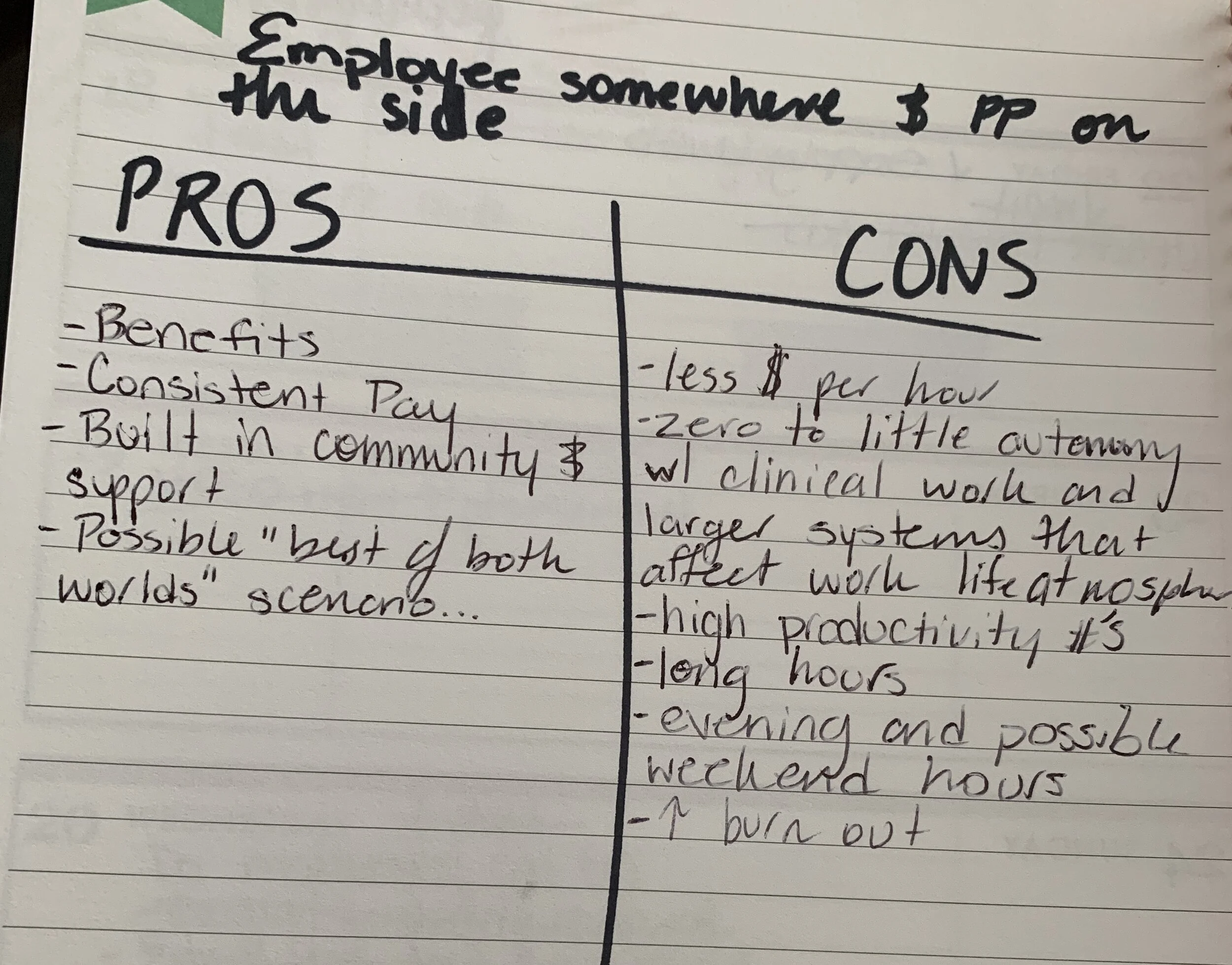
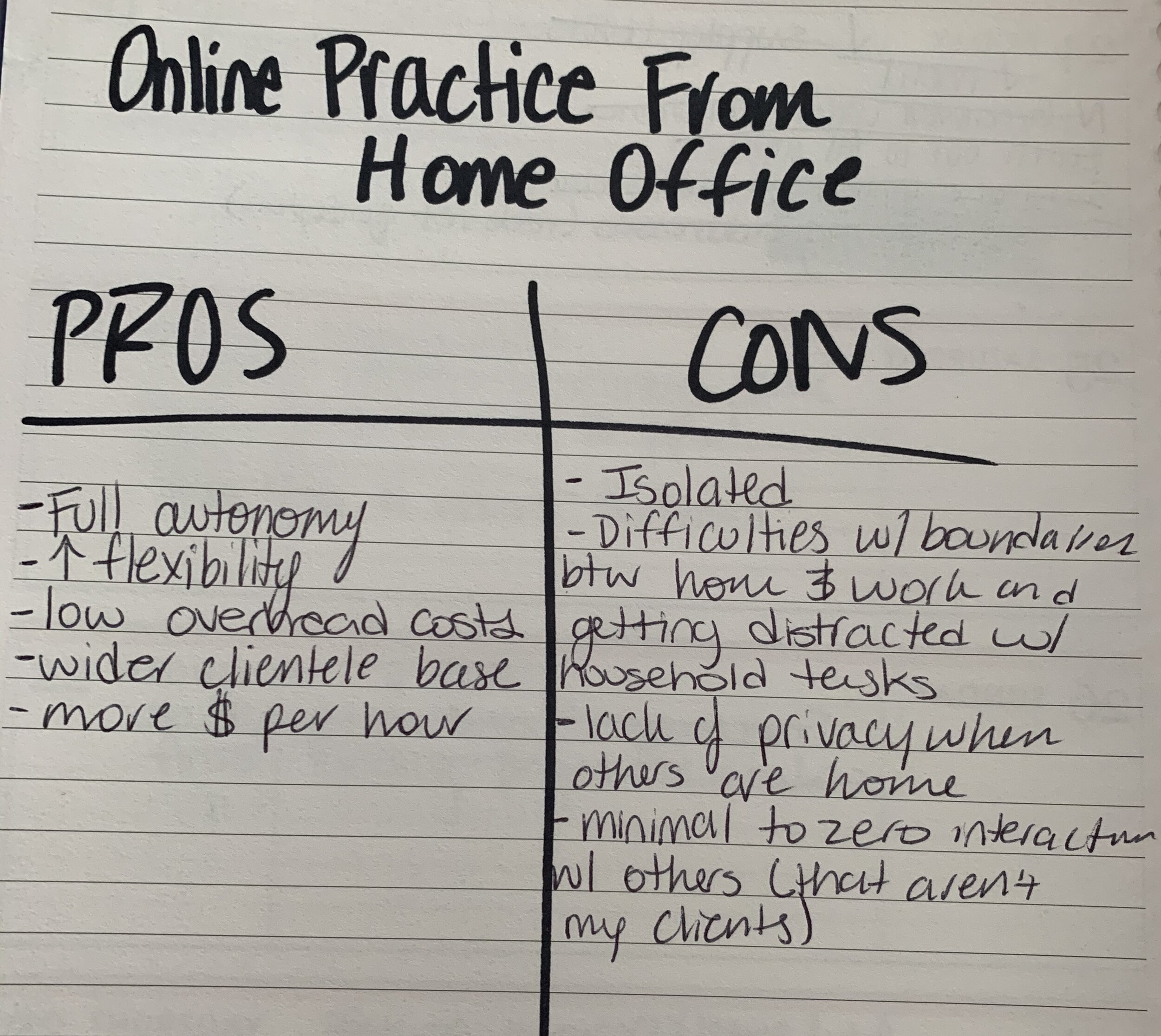
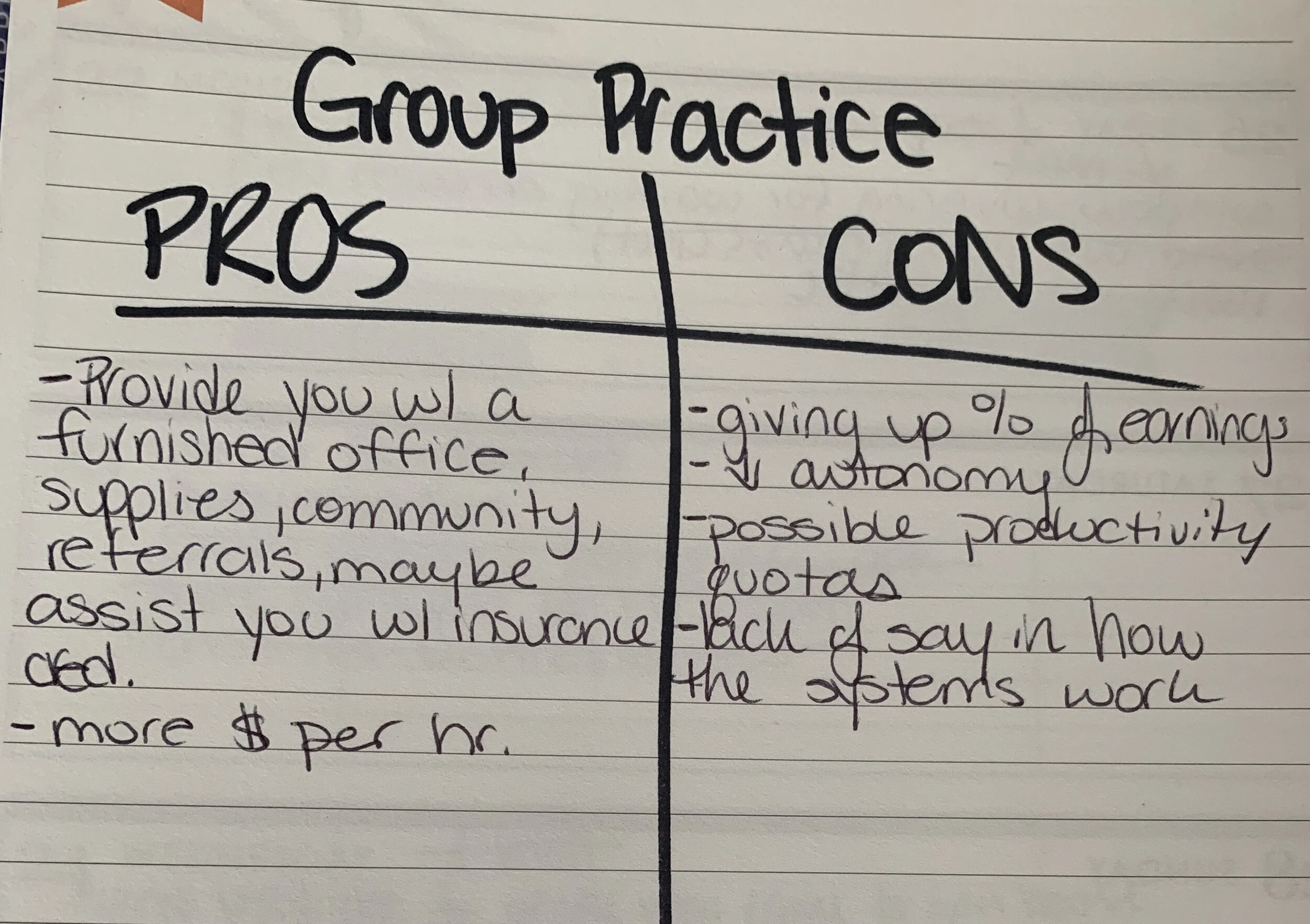
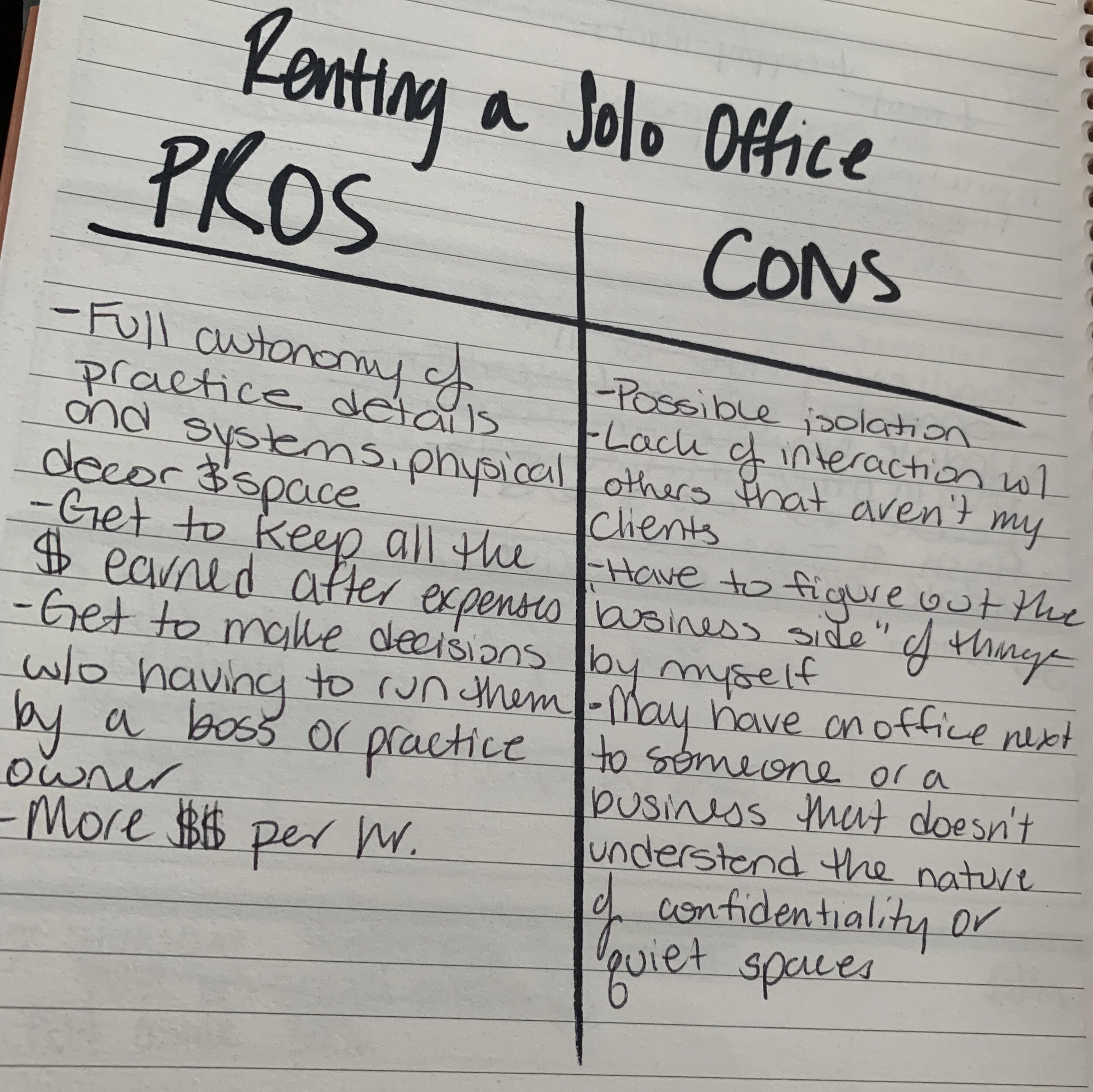
Ugh. Eh. Ugh.
Ended up being bummed that my pros and cons idea didn’t sell me on one of these ideas. I just knew that I wasn’t going to get all my needs (and wants) met by doing one of the these options above and that I wasn’t about to leave a stable full time job to do a gig that I would end up resenting a year down the road and find myself in this exact same spot.
So, back to Google it is. Searched and searched and searched and stumbled across some wise words (don’t remember who said them or what site i found them on) so ill paraphrase…
Doing something new and on your own taps into all different parts of you that you never knew where there. Building a private practice is just as emotionally draining (if not more) then physically demanding and that in order to survive the business startup phase one must be very clear about their hopes, dreams and visions for their practice before starting.
It of course occurred to me that building a business would be work (hard work) but I had not given the emotional side of it much thought before stumbling across these wise words (leave it to the therapist to forget about emotions!) ha. Outside of the fact that I knew I wanted to have more autonomy of my schedule, clientele and finances, I didn’t spend much time thinking about how i wanted my practice and life to look like “in the ideal world”.
So, I spent some time making a list…
I am the owner of my business, in charge of what’s going on with the finances, what decisions are being made day to day…
I don’t want to have employees or contractors working for me
I want full autonomy to do what I want when I want to and to not do what I don’t want to do when I don’t want to do it (all while abiding by my licensure guidelines and code of ethics of course!)
I want a beautiful office that I like and feel comfortable in and that is welcoming to my clients. I want it to be serene, nicely decorated and have modern furnishings in it. I will not have my office look like my past therapists offices have….#StraightFromGrandmasLivingRoom
I want to feel physically and financially safe
I would like my services to be accessible (physically and/or financially) to a variety of different populations
I NEED to have interaction with people (other than my clients) throughout the day. Maybe just seeing people in the halls, having some small talk, or having someone else nearby in case a safety issue occurs
I want to be able to work when I want to work and not work when I don’t have to work. Ideally, I would like to see clients two days a week with morning, afternoon and evening availability and not see clients the other days unless it’s an emergency
I want more time off
I want to be surrounded by like minded individuals
I want ease and simplicity
Though some of these traits were in each of the pros lists from above, I knew that community and having full autonomy of my practice were my NON-NEGOTIABLES and those two traits together were not found in any of the options above.
So I thought and thought and thought and debated on changing my wants and needs and in the end came to the conclusion that there is a reason all of these items are on my list and that they are important and can’t just be tossed to the side.
Back to Google it is then.
I Googled and Googled and Googled and with the combined knowledge from lots of different sites, blogs, videos and my own experience, wants and needs the general thought of a shared workspace for mental health professionals came to mind.
This isn’t a new concept and has been done in various larger cities around the nation and cmon it’s 2018 and co working spaces are hot. There is WeWork, Regus, The Park, Story, and on and on. In general these spaces are fantabulous and meet the needs of tons of solo entrepreneurs, but they don’t always meet the unique needs of mental health and wellness professionals (HIPAA, confidentiality, privacy, volume control, etc.). So I thought “Really, there should be one place where human helpers can go to find all these integral resources (office, consultation, networking, community, clinical and business building resources and support etc.).”
AHA!
The idea was born :) That thought in May of 2018 (and lots more Googling) led me to creating b.mindful Louisville.
From the idea of being simply an office space designed with mental health and wellness professionals in mind to what it is today, it has evolved quite a bit.
Today we are a safe, clean, practical, and modern office space for mental health and wellness professionals in private practice. We offer flexible rental plans and make it easy for clinicians to enter the office each day feeling confident & prepared to tackle what the world brings to them. By becoming a part of our community, one will be provided with the like-minded support network (that one so desperately needs in this field), as well as all the furnishings, supplies, amenities and resources to support a thriving practice.
In the coming weeks, months and years we will continue to evolve and meet the needs of our Louisville community. We are so grateful for all the love and support we have received thus far, and are excited to see what the future has in store for us!
We would love to hear from you about your wants and needs as a mental health or wellness professional so we can cater our content, amenities and business goals to meet our consumer’s needs! Leave a comment below.
Learn more about of clinical and business focused consultations groups here.
If you are local to Kentucky and needing an office space in Louisville, give us a call at 502-528-1363 or schedule your tour today!

Why Psychiatrists Should Rent Furnished Offices
Unlike other solo entrepreneurs who can hang their shingle at any local Louisville coffee shop or out of their house, as psychiatrists you don’t have that same luxury. In order to abide by HIPAA and/or maintain confidentiality for our clients we have to have a private, safe and neutral space to meet with them in. This barrier can add a lot of additional costs and stress onto our plates, which quite honestly turns away a lot of clinicians from getting into private practice in the first place.
Unlike other solo entrepreneurs who can hang their shingle at any local Louisville coffee shop or out of their house, as psychiatrists you don’t have that same luxury. In order to abide by HIPAA and/or maintain confidentiality for our clients you have to have a private, safe and neutral space to meet with them in. This barrier can add a lot of additional costs and stress onto your plate. Which quite honestly turns away a lot of clinicians from getting into private practice in the first place.
Going through the office hunt process = headache
Signing a long-term commercial lease (2-5 years on average) = Yikes! Most of us don’t have clients when we are first opening up shop (therefore no income), so committing to a lease for that long can be hard to wrap your head around
Furnishing said office = $$$
Upkeeping said office = Décor, cleaning, trash, restocking supplies, paying bills, etc.
Why Psychiatrists Should Rent Furnished Offices
Ease
Instead of having to worry about all the items listed above, all you have to do is market your services, come in, do your work, write some notes, fill the scripts and leave. Don’t worry about cleaning the office, or paying the LG&E bill, or stocking office supplies or anything! Just come and do what you were trained to do and get back to your life outside the office.
Low startup costs
If you aren’t having to put down a hefty security deposit, and furnish an office and waiting area, your startup costs are going to be drastically lower. Therefore, allowing you to start a practice for hundreds, and not thousands of dollars.
Design
If you are renting a furnished space, it is advised to rent a space that is used or has been designed by a like minded individual.
Best to rent another psychiatrists office when he/she isn’t using it or from an office suite such as b.mindful Louisville, Therapy Space, or Alma. Each of these spaces have offices for rent by the hour or by the day and was designed by a counselor with others in the field in mind.
By doing this you will avoid renting a furnished space with a huge conference table in it, or a very large desk with a chair on either side of it and get a space with comfortable seating for you and your clients, soft lighting opposed to harsh overhead lighting, multiple clocks to be seen by all, calming décor, sound machines and more.
Possible amenities
Dependent on the furnished office you are looking at renting, some of them may come with amenities such as printer/scanner/fax machine, WIFI, address for your business, onsite parking, private waiting room, complimentary drinks, etc.
Time
If you are like most psychiatrists starting your own practice, this isn’t your only gig. Maybe you work full or part time at an agency or hospital and/or you are a mother/father or caregiver for someone else, maybe you are dealing with your own health issues and the list goes on and on as to what takes up time in our day to day lives.
So, if you want to throw some love your way, save yourself the headache and time of having to get your own office, and rent one that is already set up, designed with you in mind and ready for you to come in and do the work you were trained to do.
Smart
You don’t work 24/7 (and if you do, stop that! #selfcare), so don’t rent and pay for an office 24/7. There are 168 hours in a week and most of us are only needing a clinical office for about 20 or so hours (dependent on your case load).
Perks of the digital age is that our documentation, marketing, expense tracking and other business-related tasks can be done anywhere. So be smart with your money and invest it where it counts the most. Rent an office for your client appointments by the hour or by the day, and do the rest of your work from home, in a shared break area, or from your favorite Louisville coffee shop or establishment.
Learn more about b.mindful Louisville and the office rentals we have for psychiatrists in the greater Louisville, KY area. Reach out to Shannon Gonter ( 502-528-1363 / shannon@bmindfullouisville.com ) with any questions or to set up your tour.

Business Consultation
On top of the clinical consultation groups we host for licensed mental health professionals, we also host a monthly consultation group focused on private practice building. This group was designed to ensure we are all up to date on the best practices from the business side of running things and to share tips, tricks and advice in regard to networking, marketing, tracking finances, etc.
Business Consultation Group For Those Thinking About Or In Private Practice
On top of the clinical consultation groups we host for licensed mental health professionals, we also host a monthly consultation group focused on private practice building. This group was designed to ensure we are all up to date on the best practices from the business side of running things and to share tips, tricks and advice in regard to networking, marketing, tracking finances, etc.
For the bulk of us, our formal clinical trainings taught us nothing about how to start a business, track expenses, keep up with social media, maintain HIPAA compliance on our own, learn the importance of networking and how to market yourself ethically, etc.
We typically do a fantastic job on the clinical front (keeping up with our required CEUs, keeping up to date with recent research findings, clinical consultation, etc.) but we often lack that same mindset and support for the business side of our practices.
This group was designed out of necessity for those of us in private practice to share the wealth of knowledge with each other and support each other on the business front of what we do. With this shared knowledge and support we can strengthen the mental health and wellness community in Louisville and reduce some (of the many) barriers of entry for clinicians looking to start a practice on their own.
During this group, we will focus on the business side of your practice, sharing and learning business tips, tricks and hearing advice from other health and wellness business owners in the area.
Details:
Requirements:
- Must be currently in private practice or looking to go into private practice.
- Must be a licensed mental health (LPCA, LPCC, LCSW, LMFT,LPAT, etc…) or wellness professional to attend this consultation group.
Learn more here.
Written by Shannon Gonter, LPCC
If you are interested in learning more about our services, rentals or looking for a like-minded community for your mental health or wellness practice contact Shannon today at 502-528-1363 or at Shannon@bmindfullouisville.com

Clinical Consultation
We all know that our chosen lines of work have extremely high burn out rates and that private practice life can often lead to isolation. Therefore, as professionals in the field that are wanting to remain in the field for years to come, we have to be hyper aware of ourselves and the ways to effectively combat the high rates of burn out and loneliness.
Clinical Consultation For Licensed Mental Health Professionals
We all know that our chosen lines of work have extremely high burn out rates and that private practice life can often lead to isolation. Therefore, as professionals in the field that are wanting to remain in the field for years to come, we have to be hyper aware of ourselves and the ways to effectively combat the high rates of burn out and loneliness.
If you are in the Louisville, KY area and are a licensed mental health professional come out and join our clinical consultation group. Learn more here.
We’ve got to be vigilant about our own self-care.

Yes, I am talking about the yoga, the massages, and taking a legitimate lunch break (not shoving your face at your desk while typing notes). But I am also talking about building your own like-minded community to support you as a person and as a human helper.
There are lots of different ways this can be done, but one of the best ways to do this is to increase your involvement with your clinical community and join a clinical consultation group.
Clinical consultation groups for licensed mental health professionals are designed to:
- Improve or refine your clinical skills
- Develop new therapeutic techniques and perspectives
- Getting and giving suggestions on how to handle difficult therapeutic cases
- Receive feedback on ethical issues
- Receive emotional support from colleagues
- Enhance your referral network by building relationships with other professionals
- Keep you up-to-date with local mental health resources
We all seek supervision and consultation during our required supervision period, but it seems like once we receive our full licenses and aren’t required to consult, we don’t. We need to do better at this. For ourselves, for our clients, and for each other.
We need to integrate consultations into our weekly schedules and make it a priority to surround ourselves with like-minded individuals.
We all know how stressful our chosen careers can be and because we can’t go home and process our days with our friends, families and partners, we need to have a safe space to share and process these moments with trusted colleagues. Remember that this is your community of support.
So find a consultation group that fits your needs!
We hear hard things, we sit with people that are in tough situations, we hold all their stories and keep them safe when they might not know how to do that for themselves yet.
b.mindful Louisville believes that community is at the root of everything good!
Written by: Shannon Gonter, LPCC and founder of b.mindful Louisville
If you are in the Louisville, KY area and are needing a furnished office space for your mental health or wellness private practice, reach out to Shannon at 502-528-1363 to schedule your your today!

Personal Route To Private Practice
I am a licensed professional clinical counselor in part time private practice, and the founder of b.mindful Louisville which is Louisville’s first shared workspace in Louisville, KY for mental health and wellness professionals. I split my time between the two businesses and wouldn’t have it any other way. I thank myself for having the courage to follow my dreams and I thank my friends and family for all the support, love and assistance they have thrown my way throughout this journey.
My personal route to private practice
Hey! I’m Shannon. A native Floridian who found herself moving to Kentucky for graduate school in 2014. Prior to moving, I graduated from Florida State University in 2013 with an elementary education degree and aspirations of attending graduate school and becoming a school counselor. During the research phase of various programs and graduate schools, I stumbled across the “community mental health” track that ran parallel to the school counseling track at several of the programs I was looking into.
I was immediately more drawn to this route but had a difficult time grappling with the concept of not “using” my undergraduate degree. After several hours on the computer Googling and multiple conversations with friends and family members, I decided to follow my gut and sign up for the required prerequisite undergraduate courses (since I hadn’t taken a psychology course since high school) needed to apply for the community mental health counseling tracks. After several applications were sent in and interviews were had, I landed on University of Louisville and attended their graduate program for clinical mental health counseling.
Never in a million years did I think I would live in Kentucky, and at the time I was highly motivated to move here to be near family that had recently moved to Louisville. To my surprise, I fell in love with the city very quickly and after graduation in 2016 I decided to put down some roots and I now call Louisville, Kentucky my home.
Throughout schooling I interned at various community mental health agencies and ended my internship at a local psychiatric hospital. After graduation, I was hired on at this hospital as a full-time therapist in the children’s outpatient partial hospitalization program and started racking up the direct clinical hours needed for my full licensure requirements.
About a year after graduation I received a scholarship to attend the Wayne Institute of Advanced Psychotherapy certification program where I depended my knowledge base of psychodynamic therapy and heightened my clinical expertise as a treatment provider. This year long program assisted me in doing this by collaborating with a diverse group of professionals from around the world and with an interactive learning environment with hands on experience, vivid study material and group discussions.
Another very important thing this program did for me was re-open my eyes to the world of private practice. I hadn’t thought about it in quite some time and honestly forgot that at the beginning of graduate school I wanted to open my own practice. I just never took the time to pause and see that along the way my dreams and visions for the future shifted based off fear of inconsistent pay and that shear fact that private practice was painted by my professors as something that we might get to do at the end of our times in the field but definitely not something that should be done immediately after graduation.
Anyways, back to the postgraduate work I did and how given the structure of psychodynamic therapy and its long-term components, the clients I currently had at the hospital were not always the best fit for the case consultations due to the programs short term nature. Therefore, during the program I started seeing 1-2 clients in the evenings in a colleague’s office for purposes of the program and to fully learn, digest and apply the material we were studying.
At time it I was just so caught up in life, working full time and keeping up with the course materials that I didn’t even realize that I had opened up a private practice (or “hung my own shingle” as one of my graduate professors used to always say). Though it was small and not quite structured in the ways it should have been, it was mine. I quickly learned that I LOVED the work I was doing with my private practice clients and having full autonomy (with respect to my licensing board, ha) of what was and what wasn’t part of my practice .
After the completion of the program, I decided to pick up a few more private practice clients and “legitimize” my practice with a name, business entity, website, and so forth. After my full-time gig was over, I would head to my colleagues private practice office that she let me rent by the hour and I saw a handful of private practice clients then went home. Sleep. Repeat. Repeat. Repeat.
After a handful of months, I noticed more and more of my thoughts were becoming consumed with private practice this private practice that. I loved the energy that this new venture was giving me. At the same time, this made me realize that the work I was doing at the hospital was not hitting me in the same way it used to. Not that the work I was doing there wasn’t meaningful or needed (because it was very much both of those) but I just knew private practice was sitting with me in a different way, and that I liked that feeling.
I am a firm believer of following your dreams (whatever they may be) and getting there in whatever fashion suits you best. For me that looked like switching from full time to PRN at the hospital after completing my supervision and receiving my full licensure and spending more of my time and energy on my private practice. During this time, I started to look for my own office and really took a deep dive into practice building. I read just about every blog I could find and listened to all of Allison Puryear and Joe Sanok’s podcast episodes on the ins and outs of building and maintaining a practice.
Even though I knew this was the path I wanted and needed to take I couldn’t help but feel that I was doing something “wrong” or that I hadn’t “paid my dues” long enough. This wasn’t because I was making the wrong decision or that the individuals around me weren’t supportive, but more so something I just felt like I “should” feel because I was doing something “out of the norm”. What I quickly realized, was that this feeling was (unfortunately) often felt by many young therapists and that its roots were ingrained deep into some larger systemic issues within our field.
Once I was able to separate myself from others and stop the comparison game, I noticed a complete shift and it wasn’t long before my entrepreneurial brain took over. This led to the idea to create a shared workspace for mental health and wellness professionals. Learn more about how that idea came to be and how I turned that dream into a reality here.
Anyways, nowadays I am a licensed professional clinical counselor in part time private practice, and the founder of b.mindful Louisville which is Louisville’s first shared workspace in Louisville, KY for mental health and wellness professionals. I split my time between the two businesses and wouldn’t have it any other way. I thank myself for having the courage to follow my dreams and I thank my friends and family for all the support, love and assistance they have thrown my way throughout this journey.
Peace and love.
XOX
Shannon
“I want clinicians to feel empowered in the work that they do so they can bring their best selves to sessions and provide for their clients in the best ways possible.”
Learn more about the shared workspace and offices of b.mindful Louisville or reach out to Shannon Gonter if you are a human helper in the greater Louisville , KY area.

Why Psychologists Should Rent Furnished Offices
Unlike other solo entrepreneurs who can hang their shingle at any local Louisville coffee shop or out of their house, as psychologists you don’t have that same luxury. In order to abide by HIPAA and/or maintain confidentiality for our clients we have to have a private, safe and neutral space to meet with them in. This barrier can add a lot of additional costs and stress onto our plates, which quite honestly turns away a lot of clinicians from getting into private practice in the first place.
Unlike other solo entrepreneurs who can hang their shingle at any local Louisville coffee shop or out of their house, as psychologists we don’t have that same luxury. In order to abide by HIPAA and/or maintain confidentiality for our clients we have to have a private, safe and neutral space to meet with them in. This barrier can add a lot of additional costs and stress onto our plates, which quite honestly turns away a lot of clinicians from getting into private practice in the first place.
Going through the office hunt process = headache
Signing a long-term commercial lease (2-5 years on average) = Yikes! Most of us don’t have clients when we are first opening up shop (therefore no income), so committing to a lease for that long can be hard to wrap your head around
Furnishing said office = $$$
Upkeeping said office = Décor, cleaning, trash, restocking supplies, paying bills, etc.
Why Psychologists Should Rent Furnished Offices
Ease
Instead of having to worry about all the items listed above, all you have to do is market your services, come in, do your work and leave.
Low startup costs
If you aren’t having to put down a hefty security deposit, and furnish an office and waiting area, your startup costs are going to be drastically lower. Therefore, allowing you to start a practice for hundreds, and not thousands of dollars .
Design
If you are renting a furnished space, it is advised to rent a space that is used or has been designed by a like minded individual.
Best to rent another licensed professional clinical psychologists office when he/she isn’t using it or from an office suite such as b.mindful Louisville that has offices for rent by the hour or by the day and was designed by a counselor with others in the field in mind.
By doing this you will avoid renting a furnished space with a huge conference table in it, or a very large desk with a chair on either side of it and get a space with comfortable seating for you and your clients, soft lighting opposed to harsh overhead lighting, multiple clocks to be seen by all, calming décor, sound machines and more.
Possible amenities
Dependent on the furnished office you are looking at renting, some of them may come with amenities such as printer/scanner/fax machine, WIFI, address for your business, onsite parking, private waiting room, complimentary drinks, etc.
Time
If you are like most psychologists starting your own practice, this isn’t your only gig. Maybe you work full or part time at an agency or hospital and/or you are a mother/father or caregiver for someone else, maybe you are dealing with your own health issues and the list goes on and on as to what takes up time in our day to day lives.
So, if you want to throw some love your way, save yourself the headache and time of having to get your own office, and rent one that is already set up, designed with you in mind and ready for you to come in and do the work you were trained to do.
Smart
You don’t work 24/7 (and if you do, stop that! #selfcare), so don’t rent and pay for an office 24/7. There are 168 hours in a week and most of us are only needing a clinical office for about 20 or so hours (dependent on your case load).
Perks of the digital age is that our documentation, marketing, expense tracking and other business-related tasks can be done anywhere. So be smart with your money and invest it where it counts the most. Rent an office for your client appointments by the hour or by the day, and do the rest of your work from home, in a shared break area, or from your favorite Louisville coffee shop or establishment.
Learn more about b.mindful Louisville and the office rentals we have for psychologists in the greater Louisville, KY area. Reach out to Shannon Gonter ( 502-528-1363 / shannon@bmindfullouisville.com ) with any questions or to set up your tour.

How To Open Up Mental Health Private Practice
Not the only things that have to be done, but to start down the road to private practice make sure you have the proper licensure, figure out why you want to do private practice, Find a business structure that meets your needs, follow business coaches & download their free resources, apply for an NPI #, research business entities and find one that works for you, apply for an EIN #, Find an office, make sure your practice is covered with all the appropriate insurances…
Lots of steps to hanging your own shingle. Below you will find the 9 logistical steps to opening a private practice for you mental health or wellness practice. These are not the only things that need to be done, but this will get you on the right path.
1.Proper Licensure
Make sure you are properly licensed for private practice
Certain states/licenses dictate a certain amount of post graduate hours before hanging your own shingle.
Check with your state board
Kentucky Professional Licensing Directory click here
2.Figure out the answer to:
Why do I want to do private practice?
How do I hope it will make me feel?
What will I do if it doesn’t make me feel that way?
How will I measure my accomplishments throughout the process?
How will I adjust and shift to make sure my work and life goals are still in alignment?
Whether it be 10 pages long, or one paragraph, put it down on paper and make it fit your current business goals.
Allow yourself to alter it along the way as needed.
3.Business Structures
Pick what structure works for you and your business. Pick one that suits your needs now and know that this can always be shifted down the road to accommodate for growing needs and dreams.

4.Find a private practice guru (there are tons) and sign up for their freebies!
No need to reinvent the wheel when others have paved the path before you!
Allison Puryear with Abundance Practice Builders
Joe Sanok with Practice of the Practice
Kate & Katie with Private Practice Startup
Gordon with Practice of Therapy
Laura with Your Badass Therapy Practice
Kelly + Miranda with Private Practice Experts
Lynn Grodzki with Private Practice Success
5.NPI #
The National Provider Identifier (NPI) is a Health Insurance Portability and Accountability Act (HIPAA) Administrative Standard. An NPI is a unique identification number for covered health care providers, created to improve the efficiency and effectiveness of electronic transmission of health information. Covered health care providers and all health plans and health care clearinghouses must use NPIs in their administrative and financial transactions.
You’d think you would know if you had one, but you would be surprised by the number of people that have one that never knew. So, see if you already have one here.
If not, apply here (its free)
6.Business Entities

Click here to learn more about the options
Most common ones in Kentucky are going to be sole proprietorship, LLC, or PLLC
7.EIN
A federal employer identification number (EIN) is a nine-digit number the IRS assigns to businesses for tax filing and reporting purposes.
Sole proprietors are the only business entity that are allowed to not obtain an EIN and use their SS#l instead.
Suggested to obtain an EIN for all business entities to have an added protection against identify fraud (because if not you would have to use your social on all paperwork and some that may be distributed to your clients).
Click here to apply (its free)
8.Find An Office
Make sure that it is private and that you, your clients and their information is safe. Don’t rush into signing a lease because it’s the first one you found. Do your research and take your time.
Confidentiality thoughts
Entrance/exit for clients
If possible, have these be separate for heightened confidentiality
Waiting area for clients
Things to think about when designing yours
File storage
Check with your board to ensure you are complying with their guidelines
Sound between office walls
Steps to take to assist in lowering the noise travel
To get all of this and more, check out shared workspaces such as Alma, Therapy Space and b.mindful Louisville. These locations are designed with mental health professionals specifically in mind to ensure meeting all the unique needs this field has.
9.Make Sure Your Practice Is Covered With Appropriate Insurance
Professional Liability
Professional liability insurance helps protect professional advice- and service-providing individuals and companies from bearing the full cost of defending against a negligence claim made by a client, and damages awarded in such a civil lawsuit. Learn more here.
General Liability
General liability insurance often referred to as business liability insurance, is coverage that can protect you from a variety of claims including bodily injury, property damage, personal injury and others that can arise from your business operations. Learn more here.
Property Coverage/Renters Insurance
Your landlord’s insurance will typically only cover physical damage to the space and not your physical items in the space. So, let’s say there is a break in at your office, your landlord’s insurance would cover the broken windows, doors, or damage to the physical property but not your personal items that were taken. That is where your renter’s insurance would step in and cover your computer, office supplies, telephones that were stolen. Learn more here.
If you want to start your practice on the right foot, have a nice furnished space and have access to additional practice building resources, and a close knit community check out b.mindful Louisville. We have had tons of clinicians start their private practices in our offices and have grown their practice quite quickly with our low overhead costs, amenities and support provided. Reach out to Shannon Gonter at 502-528-1363 or at Shannon@bmindfullouisville.com for more details.

Written by Shannon Gonter, Owner, Founder of b.mindful Louisville and professional counselor with Therapy by Shannon
Disclaimer: This is not legal or tax advice. This information is for educational purposes only. You should consult with an attorney and a CPA to determine which type of business will best meet your needs.
Disclaimer: Each state will have varying needs and requirements, please check with your individual state to ensure you are checking all the boxes!

Importance Of Insurance For Your Private Practice
There may be more insurances you need to carry for your business dependent on your license and the state you practice in. This blog will go into detail about the insurances your mental health and wellness private practice should carry.
Cover Your Ass With Insurance
There may be more insurances you need to carry for your business dependent on your license and the state you practice in (so check with your board and state), but below are some details on the three main insurances your mental health and wellness private practice should carry.
Professional Liability Insurance
Professional liability insurance helps protect professional advice given to others. It assists in spreading out and defending the individual or business against a negligence claim made by a client, and damages awarded in such a civil lawsuit. Learn more about what professional liability insurance is here.
This should be held by every practicing individual and if you are incorporated in anyway (LLC, PLLC, S corp etc.) make sure you get a “professional policy” not an “individual policy”. The professional policy will cover both you and your business, an individual policy will only cover you.
If you are not incorporated now but will be in the future, you can always start with an individual policy for protection and then/if you become incorporated, you can switch your policy to a professional account. This is easy to do by simply calling your current provider and requesting the change.
Make sure you are specific about the services you provide, ways you provide them (in person, online, group, family…) and if you have a full or part time caseload to make sure you are receiving the appropriate coverage.
Where do I go to get a policy?
Some of the most popular are:
*Suggestion to get a quote from several and compare the numbers before signing a contract. Quotes can vary greatly by state/licensure/company.
General Liability Insurance
General liability insurance is often referred to as “business liability” insurance or “slip and fall” insurnace. It is a coverage that can protect you and your business from a variety of claims including bodily injury, property damage, personal injury and others that can arise from your business operations. This can typically be added onto your malpractice insurance policy quite easily and is often required by most landlords. Learn more about it here.
Where do I go to get a policy?
Some of the most popular are:
*Suggestion to get a quote from several and compare the numbers before signing a contract
Renters Insurance
You may need to get renters insurance dependent on your current office set up.
If you are going the traditional route and are renting a solo office, or several offices and furnishing them yourself, you definitely need to carry renters insurance. This is because your landlord’s insurance policy will typically only cover physical damage to the space and not your physical items in the space. So, let’s say there is a break in at your office, your landlord’s insurance would cover the broken windows, doors, or damage to the physical property but not your personal items that were taken (computer, couch, tables, decor, supplies…). That is where your renter’s insurance policy would step in and cover your computer, office supplies, telephones, etc. that were stolen. Learn more about renters insurance here.
If you are subleasing a furnished office or using a shared workspace such as b.mindful Louisville you may not have to carry property insurance (which can save you a lot of $ each year). With the subleasing model, clinicians are typically leaving minimal items on property (if any), and typically these items being inexpensive. With this structure, if there was an unfortunate event on property and those items where damaged or stolen, they may not even total up to the insurance deductible amount, therefore leaving you with the sole responsibility to pay to replace the items. Meaning, in some cases, the subleasing model can totally eliminate the need to carry renters insurance, therefore lowering the financial overhead by quite a bit and allowing the clinician to take home more money for themselves. .
*Most landlords will require your business to have renters insurance if you are completely furnishing the space, but most shared workspaces will have you sign a “property insurance waiver”. This allows you to save money each month by not paying for renters insurance when you aren’t leaving items on property but also lays down the line to protect the individual you are renting from.
Where do I go to get a policy?
Suggestion to check with your current homeowners or rental insurance agency to see if they offer coverage for commercial offices and if so, you can usually just add it onto your current policy.
Sharon Stivers is local to Louisville, KY and works with Kiely, Hines and Associates Insurance Agency and can assist you in getting navigating the insurance world and putting together a quote for you and your business.
State Farm can also provide quotes for you and your business.
OR add on specific property coverage to your current malpractice insurance (computer, expensive treatment tools you use…)
Please check with your attorney and insurance agent to ensure that the insurance choices you are making are the best and appropriate coverage for you and your line of work.
Disclaimer: This is not legal or tax advice. This information is for educational purposes only. You should consult with an attorney and insurance agent to determine which type of business insurance will best meet your needs.
Disclaimer: Each state will have varying needs and requirements, please check with your individual state to ensure you are checking all the boxes!
If you are in the Louisville, KY area and interested in learning more about the opportunities b.mindful Louisville has for you and your private practice, don’t hesitate to reach out t o Shannon Gonter.
Why Social Workers Should Rent Furnished Offices
Unlike other solo entrepreneurs who can hang their shingle at any local Louisville coffee shop or out of their house, as socials workers we don’t have that same luxury. In order to abide by HIPAA and/or maintain confidentiality for our clients we have to have a private, safe and neutral space to meet with them in. This barrier can add a lot of additional costs and stress onto our plates, which quite honestly turns away a lot of clinicians from getting into private practice in the first place.
Unlike other solo entrepreneurs who can hang their shingle at any local Louisville coffee shop or out of their house, as socials workers we don’t have that same luxury. In order to abide by HIPAA and/or maintain confidentiality for our clients we have to have a private, safe and neutral space to meet with them in. This barrier can add a lot of additional costs and stress onto our plates, which quite honestly turns away a lot of clinicians from getting into private practice in the first place.
Going through the office hunt process = headache
Signing a long-term commercial lease (2-5 years on average) = Yikes! Most of us don’t have clients when we are first opening up shop (therefore no income), so committing to a lease for that long can be hard to wrap your head around
Furnishing said office = $$$
Upkeeping said office = Décor, cleaning, trash, restocking supplies, paying bills, etc.
Why Social Workers Should Rent Furnished Offices
Ease
Instead of having to worry about all the items listed above, all you have to do is market your services, come in, do your work and leave.
Low startup costs
If you aren’t having to put down a hefty security deposit, and furnish an office and waiting area, your startup costs are going to be drastically lower. Therefore, allowing you to start a practice for hundreds, and not thousands of dollars .
Design
If you are renting a furnished space, it is advised to rent a space that is used or has been designed by a like minded individual.
Best to rent another licensed clinical social workers office when he/she isn’t using it or from an office suite such as b.mindful Louisville that has offices for rent by the hour or by the day and was designed by a counselor with others in the field in mind.
By doing this you will avoid renting a furnished space with a huge conference table in it, or a very large desk with a chair on either side of it and get a space with comfortable seating for you and your clients, soft lighting opposed to harsh overhead lighting, multiple clocks to be seen by all, calming décor, sound machines and more.
Possible amenities
Dependent on the furnished office you are looking at renting, some of them may come with amenities such as printer/scanner/fax machine, WIFI, address for your business, onsite parking, private waiting room, complimentary drinks, etc.
Time
If you are like most social workers starting your own practice, this isn’t your only gig. Maybe you work full or part time at an agency or hospital and/or you are a mother/father or caregiver for someone else, maybe you are dealing with your own health issues and the list goes on and on as to what takes up time in our day to day lives.
So, if you want to throw some love your way, save yourself the headache and time of having to get your own office, and rent one that is already set up, designed with you in mind and ready for you to come in and do the work you were trained to do.
Smart
You don’t work 24/7 (and if you do, stop that! #selfcare), so don’t rent and pay for an office 24/7. There are 168 hours in a week and most of us are only needing an office for about 20 or so hours (dependent on your case load- the average case load for a full-time private practice therapist is approximately 20 individuals seen on a weekly basis).
Perks of the digital age is that our documentation, marketing, expense tracking and other business-related tasks can be done anywhere. So be smart with your money and invest it where it counts the most. Rent an office for your client appointments by the hour or by the day, and do the rest of your work from home, in a shared break area, or from your favorite Louisville coffee shop or establishment.
Learn more about b.mindful Louisville and the office rentals we have for social workers in the greater Louisville, KY area. Reach out to Shannon Gonter ( 502-528-1363 / shannon@bmindfullouisville.com ) with any questions or to set up your tour.

Sliding Scale
What is a sliding scale? If I am going to use one: How do I figure out what it should be? Who do I offer it to? If I am not going to use one: What do I do if someone asks me for it?
What is a sliding scale?
Offers variable fees for services based on a customer's ability to pay. Such fees are thereby reduced for those who have lower incomes, or alternatively, less money to spare after their personal expenses, regardless of income.
Why do people offer a sliding scale?
To be able to provide services and the same level of care across the board for those with fewer resources.
If you are going to offer a sliding scale…
What will it be?
A set fee (ex. $40 across the board for everyone)
Based on client’s household income (ex. annual income x .001 = fee)
Flexible (ex. more conversationally based with client on what they can afford for weekly sessions…may be $75 for one sliding scale client and may be $30 for another)
How will you determine who gets to use your sliding scale?
This is important to figure out before you start getting calls. If not you may just start offering your sliding scale to anyone who pauses after hearing your full fee.
If a client does meet your criteria for sliding scale or cannot afford your full fee or sliding scale spot it is important to have a handful of providers on hand that you trust and know will slide lower than you do.
Figure out how many sliding scale spots will you have in your caseload?
Some clinicians have an entire practice of sliding scale clients, and others set a limit on how many sliding scale clients they will take at a time (maybe 1, 2, 3 or 4 based on their caseload size).
If you aren’t going to offer a sliding scale…
Make sure you have a solid referral list for individuals that cannot afford your full fee or that you are not paneled with so you can point them in the direction of someone who might be able to meet their financial needs.
Having a hard time deciding?
Open Path Collective is a fantastic company for mental health professionals to use that streamlines the sliding scale process for you. Open Path generates referrals for your sliding scale slots, advertises your practice profile for free, and enhances your ability to serve your community.
If referring out because you don’t offer a sliding scale, or are full-- You can always refer prospective clients to Open Path Collective for affordable therapy. If clients meet the needs requirements set by Open Path, they can receive reduced rate therapy for a lifetime membership fee of $50! They can then log on anywhere nationwide and find a clinician through their directory.
Listen here to learn more.

Written by: Shannon Gonter, Founder, LPCC
Here at b.mindful Louisville, we not only provide our tenants with a comfortable, modern and safe space to practice out of but we also like to have an open dialogue around these topics and more. We have structured consultation hours to frame the conversation but also just find it beneficial to be open and transparent with one another about best clinical and business practices to assist each other in tackling the world of private practice. We are better together, if one of us succeeds we all succeed.
To learn more about the shared workspace of b.mindful Louisville click here, or call Shannon Gonter at 502-528-1363 to book your tour today.

Getting Paid In Private Practice
In graduate school we are told that we will graduate, get a job and then work for what we get hired for. If we are lucky, we will get a raise each year (to keep up with inflation), keep working our hours and getting our bi-weekly paychecks. In private practice getting paid looks quite different than it does within the employment model or at a hospital, or agency.
Here at b.mindful Louisville, we not only provide our tenants with a comfortable, modern and safe space to practice out of but we also like to have an open dialogue around these topics and more. We have partnerships with billing companies to provide our tenants with discounted rates and wide knowledge base of the best practices and systems to use in your practice.
We have structured consultation hours to frame these conversations but also just find it beneficial to be open and transparent with one another about best clinical and business practices to assist each other in tackling the world of private practice. We are better together, if one of us succeeds we all succeed.
In graduate school we are told that we will graduate, get a job and then work for what we get hired for. If we are lucky, we will get a raise each year (to keep up with inflation), keep working our hours and getting our bi-weekly paychecks.
In private practice getting paid looks quite different than it does within the employment model or at a hospital, or agency.
Side note: Being in private practice is a commitment to having inconsistent pay at times, and therefore it is suggested to have various streams of income. Some people create courses, workshops, groups, trainings, supervision, or other non-clinical income streams to assist with these inconsistencies. Learn more about that here.
For this post we will be specifically focus on how we get paid for “butt in seat” clinical hours spent in our practices with our clients.
Easy break down, we get paid by our clients (private pay), or on behalf of our clients from their insurance companies.
Private Pay
Private Pay Benefits
You typically make more per hour
You see fewer people
Paperwork is easier
Immediate payment (cash/check/card from client)
Clients are often more dedicated and follow-through on treatment
Private Pay Cons
You should specialize and niche down more to bring in your ideal client
Marketing is key because you don’t have a provided referral network (insurance company)
You need to understand how to articulate your value and be confident in your hourly fee
Cash
Simple as it seems (set fee- exchange fee- done).
In today’s world, an all cash business isn’t the most convenient for your clients or yourself. This requires your clients to go to the bank and take out money each session and for you to go to the bank multiple times a week if not every day to deposit your earnings.
Also, you must have a safe space to keep your earnings in between sessions because you aren’t going to want to have wads of cash sitting or stashed around your office.
Some clients will prefer to pay with cash (for whatever reason) and if so, make sure to be specific with them about if you will or will not have change to provide them if they do not have the exact amount.
Check
Similar to above there are some implications that come with accepting checks as a form of payment.
Make sure you write down the check # before depositing
Actually make sure that the check doesn’t bounce, and it gets deposited
Make sure you deposit it! Have known several clinicians who have filed away checks without depositing them, therefore not getting paid!
Card (debit/credit or HAS/FSA account through clients insurance)
Your EHR may be integrated with a processing software (like Simple Practice and Stripe) but if you don’t have an EHR you can get a Square, Ivy Pay, Stripe or use WRS health for a card processor.
With whatever card processing system you use, you will have to pay a processing fee but to me it is worth it and I just count it as a cost of doing business and I also write off the card processing fee so that’s nice too!
Don’t use Venmo/Paypal/other money apps, because they are not HIPAA compliant and will not sign a BAA (yet…maybe one day they will…).
For all clients, it is suggested to keep a card on file (for no shows, and late cancellation appointments).
Make sure that the client is aware what this card will be used for and that it is listed in your informed consent and/or financial agreement and that they are initialing or signing to acknowledge agreement to card policy.
If it is an insurance-based client, you will need to check with each specific contract to see if you can charge a no-show fee or charge a client at all.
Insurance
Benefits of taking insurance
You have a built-in referral network (the insurance company)
People expect to use their insurance for medical purposes
Doctors refer more often to therapists that accept insurance
Cons of taking insurance
You don’t get paid right away because you have to file the claim, have insurance review it and then you get paid.
You need an EHR (electronic health record)
If your systems are off, you sometimes will lose money and not get paid
If you decide that insurance is something that fits your practice structure, do your research on what panels to get on before just getting credentialed with all of them. See what is popular in your area (talk with other therapists and see what they take, and if there are any gaps in the market…) and pick two or three that you feel are going to benefit your practices structure the best. Could be all Medicaid, all private, EAP or a combination.
If you get credentialed and sign a contract with an insurance provider, you are an “in network” provider for them.
In network Provider
You have to get credentialed and paneled with each insurance company (process can take around 6 months give or take).
While you are waiting for credentialing, you can see people at your private pay rate or at a sliding scale fee to build up your clientele and then switch them over to an insurance-based client once you are fully paneled.
You can take care of all things billing (credentialing, verifying, maintenance, claim filing…), or you can hire out for this. Bardstown billing is a Louisville local agency that provides affordable services for mental health professionals and Practice Solutions is a nationwide biller that could assist you getting paid by insurance companies.
If you do not get credentialed and sign a contract with insurances, you are an out of network provider with them.
Out of network Provider
Providers who do not have a contract with each insurance company but provide or file a superbill for client services so the client can get reimbursed for sessions at a later date.
I am a self-pay therapist and have some clients who use superbills and I always suggest that they call their insurance provider and inquire about out of network benefits and reimbursement to maybe get an idea on what they may be reimbursed.

Private Practice Fee Setting
First thing to do when setting fees is figure out what services you provide. Do you see individuals? Couples? Children? Families? Groups? Workshops? Webinars? A little bit of everything? Do you do longer intake appointments? Will you have options for clients to do 50-minute, 60-minute or 90-minute sessions?
All clinicians need to set fees for their services (yes, yes even those insurance-based practices). Clinicians who accept insurance need to set fees because not everyone who wants to see you is going to have insurance, want to use their insurance or maybe you just aren’t paneled with their insurance company.
First thing to do when setting fees is figure out what services you provide. Do you see individuals? Couples? Children? Families? Groups? Workshops? Webinars? A little bit of everything? Do you do longer intake appointments? Will you have options for clients to do 50-minute, 60-minute or 90-minute sessions?
Think of all the options out there and paint a clear picture of what you want your practice to look like.
After this, set prices for each individual service and become comfortable with stating your prices. This is a very important step because we need to be confident in our prices so when we get prospective client calls we aren’t fumbling all over our words and reducing our fees for everyone just because we aren’t comfortable with the amount we have set.
For the services we provide, this process can look different than with other goods (tangible items) because we are essentially pricing ourselves. For the bulk of us, our service is our knowledge, compassion and skills.
Also, the mental health and wellness fields as a whole don’t do a good job at empowering us to explore our worth. We often tie it to what we hear so often “there isn’t any money in this field” or that “we are here to serve not to make money”.
For most individuals in private practice our fees and hourly rate is going to be higher, if not significantly higher, than what our hourly rate was when we were in a different setting.
These higher rates often make the clinician uncomfortable (fear of judgement from other clinicians, prospective clients, their loved ones, imposter syndrome…) and sometimes leads to clinicians setting their hourly rate quite low to begin with. This can be problematic because it may not be taking into account self-employment taxes, business expenses and lifestyle expenses.
For example, a counselor who is used to working at an agency where they approximately made $16 an hour (gross annual of about $33,000.00) charges $40 per 50-minute session in private practice thinking they will more than double their annual salary.
$40 per session x 40 hrs per week = $1600 a week x 49 weeks (3 weeks off for vacation) = $78,400 gross a year
Issue with this thinking is that full time private practice work is not 40 clinical (billable) hours a week, it is typically closer to 20.
So, it would look more like $40 per session x 20 hrs per week = $800 a week x 49 weeks (3 weeks off for vacation) = $39,200 gross a year
Which is not a lot more than the agency salary and we still haven’t paid self-employment tax or our business expenses yet.
So, let’s factor in our expenses (self-employment tax, rent, and other expenses of doing business) into our session fees.
If your monthly expenses are $1,800.00 and you typically have 20 sessions a week so 80 sessions in a 4-week month you know that $22.50 (1800 divided by 80) of each session is going straight towards expenses. Therefore, out of your $40 fee to your clients you are only seeing $17.50 of that.
Hmm…what the crap. So, what now?
1. Remember that being in private practice is a commitment to having inconsistent pay at times, so factor this in from the get-go. Maybe you raise your rates a little to account for this, maybe you see less clients per week to allow time for your side hustle, maybe you diversify your income and do groups, workshops, or something nonclinical that brings in “steady” money.
2. Know that your rates for services wont all be the same. Maybe you are doing couples and individual work and charge differently for those or maybe it’s the difference between your self pay rate, insurance-based rate and sliding scale rate. Account for these variances.
3. Don’t forget about your business expenses.
4. Remember that the services that you offer are special and needed in this world and that customers (yes your clients are consumers) expect to pay for services.
So, to figure out this “fee setting thing” let’s start with what you need to sustain your lifestyle. Maybe its $30,000.00 a year or maybe it’s $100,000.00.
Spend some time figuring this out and make sure you are factoring in all your current expenses but also accounting for having extra to save for the future (home buying, family growth, retirement, vacations, home renovations…).
After this figure out how many weeks you need off for vacation each year (I would say a minimum of 3).
Then figure out your business expenses (actual or estimated). Checklist here.
Now it’s time for the math. See full example here.
As human helping private practice owners we often forget that we are a business (because we are here to help) and that we need to make a livelihood. With not switching our therapist hat in for our business owner hat we can get in the way of our business surviving and thriving. Therefore, we need to slip our business hat on every once in awhile and make sure we are factoring expenses into the costs that we charge our clients.
Want to make $60,000 a year
Need 4 weeks off a year
Business expenses of $1200 a month
$1200 monthly business expenses x 12 months = $14,400 yearly business expenses
So, need to gross $74,400 a year to cover the expenses and bring home $60,000
If working 48 weeks a year then we need to divide $74,400 by 48 to get our weekly amount ($1550.00)
Then we can divide $1550 by the cost per session to see how many sessions we will need each week.
Ex)
$1550 divided by $60 = 26 sessions per week
$1550 divided by $80 = 19 sessions per week
$1550 divided by $90 = 17 sessions per week
$1550 divided by $100 = 15.5 sessions per week
$1550 divided by $150 = 10 sessions per week
Looking at the graphic below we see that the national averages for cost of counseling are between $75-$250 a session.

Information collected by Simple Practice
These higher hourly rates that often make people uncomfortable and lead to clinicians setting lower rates to begin with can hopefully now be looked at through a different lens. A lens that assists us in creating a fruitful life for ourselves outside the office, all while making sound business decisions and allowing us to provide the services we want to our communities.
Here at b.mindful Louisville, we not only provide our tenants with a comfortable, modern and safe space to practice out of but we also like to have an open dialogue around these topics and more. We have structured consultation hours to frame the conversation but also just find it beneficial to be open and transparent with one another about best clinical and business practices to assist each other in tackling the world of private practice. We are better together, if one of us succeeds we all succeed.

Written by: Shannon Gonter, Founder, LPCC
To learn more about the shared workspace of b.mindful Louisville click here, or call Shannon Gonter at 502-528-1363 to book your tour today.

Before, During & After A Networking Event
With most important things in life there are multiple steps and items to keep in mind before, during and after said event. So networking isn’t going to be any different (and yes networking is important). So let’s jump right into it.
With most important things in life there are multiple steps and items to keep in mind before, during and after said event. So networking isn’t going to be any different (and yes networking is important). So let’s jump right into it.
Things to keep in mind BEFORE a networking event
Do your research
What event are you going to?
Who is hosting the event?
Is there a public guest list? (to see if you know anyone else going)
What time does it start?
Is the entire event networking or is only the first 30 minutes open networking and then a talk
What’s the address?
Do you know where to park?
Dress appropriately
Is there a dress code?
Sometimes better to be overdressed than underdressed
Practice your elevator speech
Keep it short
Keep it light
Practice to make it sound natural
Get materials ready
Business cards
Promotional material (if allowed at event)
Name tag
Power in numbers
If allowed, take a friend :)
But if not, know that you will not be the only one there flying solo. Majority of people go to networking events alone and are just as nervous as you!
Things to keep in mind DURING a networking event
Name tag etiquette
Write legibly
Use your first and last name
Place it within ones eye sight line on the right side of your body
Keep your phone in your pocket/purse/bag/etc.
You will look busy to others if you are on your phone
Busy people typically don’t look approachable
Hand out your business information
Don’t let it be the first thing you do though
Don’t be pushy
Shake their hand first and/or have a conversation before handing out your cards
Best practices to ask for ones consent or interest in having your card opposed to assuming they want your information
Be yourself (easier said than done)
Focus on yourself
Might help to focus on three of the most important qualities you want to shine through in your conversations (empathy, trustworthy, organized, good listening, “normal”, good eye contact, story teller…)
Things to keep in mind AFTER a networking event
Organize information collected from others
Business card or resources collected from events should be organized. If this isn’t done soon after the event, resources and cards can often get lost or forgotten about.
DIY excel sheet
Follow Up
Do it within 24 hours
How?
You can connect via email, LinkedIn or call (majority will prefer online communication so they can respond when is most convenient for them)
What do I say?
Mention a conversation from the event, offer to help, ask to meet up…
At b.mindful Louisville we only rent to individuals that are licensed or certified mental health or wellness professionals. Therefore, making it easier for our tenants to naturally network, consult and refer to each other within our like-minded community.
We also host bi monthly socials for our tenants to step outside the office, let their hair down and get to know each other in a non-clinical atmosphere. Our tenants love this and see heightened levels of success in their practices because of built in networking opportunities.
Want to learn more about us? Message and ask away :)

Shannon Gonter, LPCC, Founder and Owner of b.mindful Louisville
Shannon Gonter, licensed professional counselor and founder/owner of b.mindful Louisville understands the nuances of private practice and finds immense joy in assisting other mental health and wellness professionals on their journal in private practice.

Networking Categories
Networking is typically used in a very general or vague way and as mental health and wellness professionals we don’t typically spend much time digging deeper into how networking could benefit us or others. For those of us who want to dig deeper, the broadness of “networking” can be confusing. It makes us feel like we have to network with anyone and everyone, and then we get overwhelmed and just don’t network with anyone (which isn’t helping anyone).
Networking is typically used in a very general or vague way and as mental health and wellness professionals we don’t typically spend much time digging deeper into how networking could benefit us or others.
For those of us who want to dig deeper, the broadness of “networking” can be confusing. It makes us feel like we have to network with anyone and everyone, and then we get overwhelmed and just don’t network with anyone (which isn’t helping anyone).
In order to avoid getting completely overwhelmed we first need to spend time thinking about our ideal clients.
Who they are…
What they do…
Where they hang out…
Who they interact with…
What their hopes and dreams are…
Once we have this picture painted it’ll help narrow our lens and point us in the direction of who we should be networking with.
For example, if our ideal client is a father who has recently divorced and is struggling with co-parenting and the transition into single adulthood. I would suggest networking with divorce attorneys (an individual every person getting a divorce has to interact with) and gyms (somewhere a recently single male might join during this transitional period) over physicians or business coaches.
But if your ideal client is an entrepreneurial spirited man who struggles with “work life balance” and stress, I would network with physicians (men are more likely to seek help from medical professionals prior to mental health professionals) and business coaches (someone they may already be in contact with to assist them in building their company) over gyms and coffee shops.
Below we will outline and break down the specific networking categories for mental health professionals.
1.Community Groups
Group of individuals from like-minded and different occupational backgrounds than you, coming together for a common purpose (networking, volunteering, advocacy…).
It can be very beneficial to be one of the (if not the only) mental health professional in the room at these events. We all know how difficult it can be to navigate the behavioral health world, therefore we can be the natural advocate for our profession as well as the connector for others. Therefore, when the individuals we network with need mental health services for themselves, their loved ones, or friends; they’ll think of us and we will be able to work with them and/or refer them to someone who is a more appropriate fit.
On the local front, you should check out:
• Young Professionals Association of Louisville (YPAL)
• Louisville Urban League Young Professionals
• Etc.
On the national front, you should check out:
• Therapists in Private Practice (TIPP)
• Etc.
2.Influencers
People, businesses, and professionals that your ideal client already has a relationship with. Idea is to build a relationship with these individuals/businesses so you can stay at the forefront of their mind when one of their clients/friends/family members is seeking mental health services you can be the first on their mind!
Examples:
Medical Providers (physicians, holistic medicine, PT, OT…)
Attorney
Accountant
Bookkeeper
CPA
Financial planner
Coffee shop
Gym (yoga studios, Crossfit,barre studios, run club, Fit 4 Mom…)
Business Coach
3.Clinical
People who do similar things to you. Maybe they have the same license as you, or maybe they don’t. Maybe they use the same theories and modalities in session as you do, and maybe they don’t. Maybe they work with the same population and niche as you, and maybe they don’t. Either way, it is beneficial for you and your business to network and be around other mental health professionals. It will provide you with an increased network of support, larger referral and consultation base and increased exposure for your business.
You can reconnect with individuals you went to graduate school with (in person or online).
You can reach out to professionals within your office building. This may be easier for those of you in a group practice with other mental health providers or those that practice out of a shared workspace such as b.mindful Louisville.
You can join local therapist exclusive Facebook page dedicated to networking.
You can join a mental health organization and attend their meetings and conferences.
You can follow and connect on social media with local providers.
You can ask other professionals to a networking coffee date.
4.Other wellness professionals
Majority of our clients are on the path to wellness and may be interested in other wellness professionals’ services before, during or after their mental health treatment. Therefore, it is important to increase your awareness and connection with other wellness providers in your community.
Including:
• Prescribers
• Psychiatrists
• Psychiatric Nurse Practitioners
• Massage therapist
• Energy work providers
• Essential oil providers
• CBD oil providers
• Life coaches
• Fitness instructors or gyms
• Nutritionist or dieticians
• Etc.
Remember that the point of networking is not to just meet as many people as possible, but to build strong, meaningful relationships with these individuals and businesses as well. Therefore, the intentionality of who you network with is just as important as how you nurture that relationship going forward.
Here at b.mindful Louisville, we only rent to licensed or certified mental health or wellness professionals. Therefore, making it easier for our tenants to naturally network, consult and refer to each other within our like-minded community. We also host bi monthly socials for our tenants to step outside the office, let their hair down and get to know each other in a non-clinical atmosphere. Our tenants love this and see heightened levels of success in their practices because of built in networking opportunities.

Shannon Gonter, Founder and Owner of b.mindful Louisville