
What do I say when I am inquiring for services with a therapist?
This is a series dedicated to answering the communities questions. You ask the question and we get them answered by health and wellness professionals in the field. Email or DM us today to submit your question @b.mindfullouisville
Question asked: What do I say when I am inquiring for services with a therapist?
Answered by: Lindsay Carney, a Licensed Clinical Social Worker. She is the co-founder of Transcend Counseling Services in Louisville, KY. Lindsay provides individual therapy to adults seeking relief from disordered eating and body shame. She currently practices using a virtual office, and offers in-person sessions on a case-by-case basis. You can learn more about her and Transcend on Facebook
The information and resources contained on this website are for informational purposes only and are not intended to assess, diagnose, or treat any medical and/or mental health disease or condition. The use of this website does not imply nor establish any type of therapist-client relationship. Furthermore, the information obtained from this site should not be considered a substitute for a thorough medical and/or mental health evaluation by an appropriately credentialed and licensed professional.

Managing Emotions When The Holidays Are Nearing
The Holidays are drawing near. For many of us, this can be extremely stressful. At a time that is expected to be filled with joy, many struggle with feelings of grief and loss, being overwhelmed by changes in routine, being around unsupportive family, and many other issues that pop up this time of year.
The Holidays are drawing near. For many of us, this can be extremely stressful. At a time that is expected to be filled with joy, many struggle with feelings of grief and loss, being overwhelmed by changes in routine, being around unsupportive family, and many other issues that pop up this time of year.
Because this time of year can be difficult, it's important to put in place some self-care strategies to help cope as you navigate through the holidays in a healthy way.
1. Set realistic expectations.
If attending three holiday parties in one weekend seems exhausting, give yourself permission to only go to one or two (or none). If planning the holiday meal is too overwhelming, ask for help. Create a reasonable budget for gifts, and don't exceed it (even if that budget is $0.00). Keeping your expectations for the season realistic will allow you to resist the pressures that the season can bring.
2. It's okay to feel sad or lonely.
Feelings of sadness, loneliness, or grief don't suddenly go away because of the holidays. In fact, these feelings are often intensified during this time of the year. There is room for these feelings during the holidays. You can choose to express these feelings or not--it's absolutely up to you. But give yourself permission to have these feelings and to nurture them in whatever way feels right to you.
3. Eat and drink in moderation.
Holidays often lead to excess consumption of food and alcohol. Monitoring this is important. Avoid over consumption if you are feeling down. It often only increases our feelings of distress.
4. Don't isolate
Take time for yourself if you need it! But don't isolate yourself. Spend time with people that are supportive and understanding. Don't be afraid to reach out to community service agencies if you need additional support.
5. Be aware of triggers
For some, the holidays may bring triggers of grief or trauma. Be aware of these, and have a plan to cope. Is there a supportive friend that can be with you or be available for a call? Do you have effective coping or relaxation skills to regulate yourself? Do you have an exit strategy if you need to leave a gathering? Having a plan in place can make you feel more prepared for the challenges the day may bring.
6. Change things up!
Try something new for the holiday season. Volunteer, spend the day with friends instead of family, or take a small trip. You can spend the holidays in whatever way feels good to you, traditions be damned!
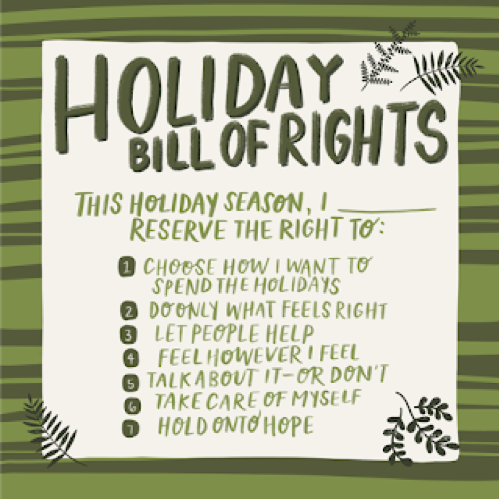
7. Follow the Holiday Bill of Rights
Captured in the image above, the Holiday Bill of Rights is a brief but helpful guideline to remembering your boundaries during the holiday season. Reflect on the ways that you can honor yourself and your feelings during the season.
May we all navigate the holidays mindfully and honor our needs.
Written by Kayla Renteria, LPCC - mental health counselor with Renteria Counseling in Louisville, KY

I work with children, adolescents, and adults with a variety of presenting concerns. Many of my clients come to me with concerns related to anxiety, depression, relationship issues, and past trauma. My experience as a therapist has provided me the opportunity to work alongside clients from many different walks of life. My philosophy on treatment is to empower my clients through a trusting relationship, compassion for their situation, understanding that they are doing the best they can with what they have, and a good measure of humor to keep things real. I specialize in treating trauma, depression, and anxiety.
I am also trained in EMDR, a highly effective and efficient treatment modality for trauma and mood disorders. I know how uncomfortable it can be to address painful moments in the past and present. I am honored to walk alongside my clients as we work to heal the past and move forward in a healthy way.
My educational and professional experiences have provided me with the expertise to guide you, utilizing evidence-based treatment principles and an unwavering sense of compassion. I would love the opportunity to talk with you about how I can help you. When you're ready, give me a call or use this link to schedule “.
The mental health and wellness professionals that practice out of b.mindful Louisville are skilled in what they do. Each specializing in their own area and caring for their clients in their own unique way.
If you need help finding the best human helper to meet your specific needs, email us for one-on-one assistance.
*The information and resources contained on this website are for informational purposes only and are not intended to assess, diagnose, or treat any medical and/or mental health disease or condition. The use of this website does not imply nor establish any type of therapist-client relationship. Furthermore, the information obtained from this site should not be considered a substitute for a thorough medical and/or mental health evaluation by an appropriately credentialed and licensed professional.

HOW TO NAME SHAME AND THEN LET IT GO
Lots and lots of emotions out there, like lots. And they fall all over the map from positive to neutral to negative (with some fluctuating on severity dependent on the given situation). My personal opinion (and a popular one) on emotions is that not a lot of emotions are inherently “bad” or “negative” to feel, it’s what we do with that emotion that can be “bad” or “negative”. But there is an exception to this rule, and I will say, with confidence, that shame can almost always be classified as a “bad” emotion.
Lots and lots of emotions out there, like lots. And they fall all over the map from positive to neutral to negative (with some fluctuating on severity dependent on the given situation). My personal opinion (and a popular one) on emotions is that not a lot of emotions are inherently “bad” or “negative” to feel, it’s what we do with that emotion that can be “bad” or “negative”. But there is an exception to this rule, and I will say, with confidence, that shame can almost always be classified as a “bad” emotion.
Now what is shame. We hear it from time to time but honestly a lot of people confuse shame with guilt. And it can get tricky to differentiate between the two sometimes. “What is shame?” or “What’s the difference between shame and guilt?” is actually the top Googled items when it comes to shame. So, let’s clear some things up before continuing on…
Guilt is “feelings of deserving blame especially for imagined offenses or from a sense of inadequacy”
Gershen Kaufman stated that, "Shame is the most disturbing experience individuals ever have about themselves; no other emotion feels more deeply disturbing because in the moment of shame the self feels wounded from within."
Therefore, the difference is that “Shame is a focus on self, guilt is a focus on behavior. Shame is, "I am bad." Guilt is, "I did something bad." – Brene Brown
So, from here on out when I talk about shame, I'm not talking about anyone actually doing anything wrong. I am talking about the feelings, and thoughts that we are somehow wrong, defective, inadequate, not good enough, or not strong enough.
To break it down a little more, lets walk through the some of the most common ways experience shame.
WITHDRAWING
Seems to be the most common response to shame. When you feel rejected or humiliated, you may begin to isolate yourself from connecting with others to avoid running into this feeling again. In the moment this may look like slumping your posture, avoiding eye contact or lowering your head. All of this makes sense and at times is a natural protective factor response to humiliation, but this eventually turns into a cycle and you may start to avoid going out with friends or often feeling “checked out”.
ATTACKING YOURSELF
No hidden psychological meaning here. This is what it says. Attacking yourself. The inner dialogue that we each have turns negative and says things like “I am stupid, I lack value, I am ugly, I am defective, I am unworthy etc.” After some time, these thoughts infect your actions and you start presenting yourself outwardly as if you are stupid, lack value or are ugly.
LACK OF BALANCE
Avoidance: Don’t like experiencing all these negative feelings? Simple solution seems to just turn them off then, right? Unfortunately, emotions don’t work like this – they don’t have an off switch. They may be turned off/ignored/repressed by you, but they are still very much a part of you and inside you. Since you are not actively engaging with them, they show up in your life through excessive drinking, drug usage, spending etc.
Doing More Of: So, let’s say you are feeling shame around your sexual activity and you have a thought that if you just do it more, and get more comfortable with it, then the shame with dissipate. Now this would work (if shame wasn’t in the picture) but shame is in the picture for you, so this strategy doesn’t work. In the end you may become more promiscuous and therefore building up your shame opposed to working to lower it.
Over Doing: Maybe you notice that you often over do, over give, over share, over strive on things that you are proud of in order to ignore those situations that bring discomfort into your life.
ATTACKING OTHERS
Appears to be a common sign of shame and comes off in varying degrees. Maybe it is putting others down, demeaning them, being cruel or even emotional and physical abuse. These are often played out to show a dominance or power over someone else (since you can’t get a handle on or take power over your feelings of shame).
SO NOW WHAT? DON’T WORRY I WON’T LEAVE YOU HANGING.
The following steps can assist you in breaking the cycle of shame.
STEP 1: NAME IT!
Think back and determine when you started feeling this way
Assess how your body experiences shame
Process those feelings (either alone or with someone else)
By doing this your relationship with shame will change and it will start to play a less powerful role in your life.
STEP 2: SET REALISTIC EXPECTATIONS
Recognize your physical, emotional and cognitive restrictions and plan accordingly. Though it is good to do your own research and read blogs, you may not find relief there. Given that shame starts in infancy and gets built on throughout our lives, there is usually a lot of items to dig through and most people see best results with assistance from a mental health professional.
STEP 3: TELL THE WORLD!
Not really. I mean you can if you want, but what I mean is talk to someone who will understand and not cast judgement on you. In the end it is our inner thoughts that are keeping us locked in the room with shame, so why not allow someone else into the room to assist in looking at it from a different light. This will often allow you to understand that we judge ourselves on a harsher scale than others judge us and eventually release the shame from the body.
STEP 4: CHANGE YOUR INNER VOICES
Adding onto the thought that we judge ourselves harsher than others judge us, try to reframe your inner voice. Think about it in terms of “would I say this to someone else” (and if not, don’t say it to yourself). Most of the time you wouldn’t, so let’s try to be kind to ourselves and shift your inner dialogue.
I understand that the title of the blog (How To Name Shame And Then Let It Go) may be misleading to some and that “if I name it, then it’ll go away and won’t come back”, but that isn’t the case with shame. Working through the shame in our lives takes time, requires active effort (on your end and often others) and hard work (months, maybe years…). So, you may think “okay then, why not name the blog something else.” Thought about it (obviously), but I just kept coming back to the process of letting go. Often change is difficult, scary and intimidating and throughout the process it may make you feel vulnerable or exposed. Involved in this process is letting go of those maladaptive behaviors that covered your shame and eventually replacing them with different, more positive and adaptive skills therefore lowering the exposed necked feelings.
Written by: Shannon Gonter, LPCC of Therapy by Shannon in Louisville, KY

I specialize in working with men and young adults. I am passionate about my career and want to work with you to create positive change. I also strive to create a counseling environment where men and young adults can relate, feel heard, and find new solutions to their negative patterns. Some issues that I most commonly work with are stress, relationship issues, difficulty saying “no” to others, difficulties recognizing emotions and emotionally connecting to others, anger, and intimacy issues, among others.
The mental health and wellness professionals that practice out of b.mindful Louisville are skilled in what they do. Each specializing in their own area and caring for their clients in their own unique way.
If you need help finding the best human helper to meet your specific needs, email us for one-on-one assistance.
The information and resources contained on this website are for informational purposes only and are not intended to assess, diagnose, or treat any medical and/or mental health disease or condition. The use of this website does not imply nor establish any type of therapist-client relationship. Furthermore, the information obtained from this site should not be considered a substitute for a thorough medical and/or mental health evaluation by an appropriately credentialed and licensed professional.

MEDITATE TO SEE YOUR PATH
Welcome to the 10-part meditation blog series that focuses on the various ways that meditation can assist you and your overall wellbeing. Each week I will publish a blog specifically dedicated to how a meditation practice can assist with lowering anxiety levels, seeing your path, help your thoughts go by more easily, etc.
Welcome to the 10-part meditation blog series that focuses on the various ways that meditation can assist you and your overall wellbeing.
Each week I will publish a blog specifically dedicated to how a meditation practice can assist with lowering anxiety levels, seeing your path, help your thoughts go by more easily, etc.
Before diving into this week’s topic, I want to take some time to provide some definitions and answer some questions to ensure that we are all on the same page.
Meditation: thinking deeply or focusing one's mind for a period of time, in silence or with the aid of chanting, for spiritual purposes or as a method of relaxation
Mindfulness: the practice of maintaining a nonjudgmental state of heightened or complete awareness of one's thoughts, emotions, or experiences on a moment-to-moment basis
WHY SHOULD I CARE ABOUT MEDITATION?
Because it has a direct connection to health benefits such as lower blood pressure, improved blood circulation, lower heart rate, less perspiration, slower respiratory rate, less anxiety, lower blood cortisol levels, more feelings of well-being, less stress and deeper relaxation.
WHO SHOULD MEDITATE?
EVERYONE! You don’t have to have some enlightened, spiritual abilities to practice meditation. You don’t have to be a yogi and go around saying namaste to everyone. You don’t have to know someone within the meditation community to be invited into it. Literally anyone from toddlers to elders can do and benefit from meditation.
WHERE SHOULD I START?
Take your time in trying out all different types of meditation and mindfulness activities to figure out what suites you best (resources provided below). After more and more time is spent meditating you will become more and more comfortable with the idea of being still and focusing your attention to your breath.
Quick Practice: Let’s Give It A Go!
1. Find a quiet space
2. Sit or lie down and get comfortable
3. Close your eyes
4. Breathe natural. Make no effort to control your breathing
5. Focus your attention on your breath. Observe your bodies movements with your breath. Focus your attention on your breath, remembering not to control it and allowing it to flow in and out naturally. When your mind wanders, that’s okay, just thank your thoughts and return your focus back to your breath.
a. Start with doing this for a few minutes, and then add one more time as your practice progresses.
RESOURCES:
Books:
How to Walk, How to Sit, How to Eat, Reconciliation
Headspace Guide to Meditation and Mindfulness
Online:
UCLA Mindful Awareness Research Center
Greater Good Science Center at UC Berkeley
YouTube:
Jon Kabat-Zinn
Pema Chodran
Sharon SalzBurg
Tara Brach
Apps:
Insight Timer-Meditation Timer
path
\ ˈpath , ˈpäth\
plural paths\ ˈpat͟hz , ˈpaths , ˈpät͟hz , ˈpäths \
DEFINITION OF PATH
(Entry 1 of 3)
1: a trodden way a winding path through the woods
2: a track specially constructed for a particular use a garden path of flagstones
3a: COURSE, ROUTEthe path of a meteor
b: a way of life, conduct, or thought decided on a career path in medicine
ADVICE ON HOW TO VISUALIZE YOUR PATH WHILE MEDITATING:
1. Allow your mind to take you on a journey and down the path it gravitates to. Maybe the scenery is in the city, on a mountain, or on the beach. Whatever it may be, allow yourself to lead you to your answers.
2. With continued practice and consistency, meditation will come easier and easier. But until you get to a space where you are comfortable with your practice, be patient with yourself and where you are at on the journey to finding your path.
3. In order to find your path, you need to practice letting go of your thoughts as they come to you. Simply thank them for coming into your awareness and store them away for later. Focus your attention back on your breath, your mantra, or a fixed area within the room.
Try it out now:
Guided Meditation – Find Your Life Purpose – Listen Here
Finding Your Path Of Joy Meditation – Listen Here
Written by: Shannon Gonter, LPCC of Therapy by Shannon in Louisville, KY
I specialize in working with men and young adults. I am passionate about my career and want to work with you to create positive change. I also strive to create a counseling environment where men and young adults can relate, feel heard, and find new solutions to their negative patterns. Some issues that I most commonly work with are stress, relationship issues, difficulty saying “no” to others, difficulties recognizing emotions and emotionally connecting to others, anger, and intimacy issues, among others.
The mental health and wellness professionals that practice out of b.mindful Louisville are skilled in what they do. Each specializing in their own area and caring for their clients in their own unique way.
If you need help finding the best human helper to meet your specific needs, email us for one-on-one assistance.
The information and resources contained on this website are for informational purposes only and are not intended to assess, diagnose, or treat any medical and/or mental health disease or condition. The use of this website does not imply nor establish any type of therapist-client relationship. Furthermore, the information obtained from this site should not be considered a substitute for a thorough medical and/or mental health evaluation by an appropriately credentialed and licensed professional.

5 Strategies to Calm Your Anxiety Quickly
When you live with an anxiety disorder, any moment can become one that creates a slow-rising panic within you. Life is normal one second and the next, you feel your chest tighten and your heart begin to race.

When you live with an anxiety disorder, any moment can become one that creates a slow-rising panic within you. Life is normal one second and the next, you feel your chest tighten and your heart begin to race. You may begin to hyper-focus on future events and find yourself getting lost in “what-ifs.”
To make matters worse, you may then begin to berate yourself for allowing the panic to get the best of you and begin to believe that all of those what-ifs are indisputable facts.
Luckily there are many powerful tools and techniques you can use to manage your anxiety effectively.
Breathe Deeply
The minute you feel a panic attack coming on, the first thing to do is stop and gain control of your breath. Deep, slow breathing sends a signal to our brains that everything is safe in our environment. Controlled breathing is one of the most powerful ways to activate your body’s relaxation response. It will take your mind and body out of “fight or flight” mode and put it instantly into a calm and relaxed state.
Accept That You are Anxious
It’s important to always remember that anxiety is “just a feeling.” And like all feelings, it can go as quickly as it came. You are having an emotional reaction to a string of thoughts. Accept your anxiety because trying to pretend it’s not happening will only make matters worse.
Let’s be clear – by accepting your anxiety, you are not resigning yourself to a life of eternal misery. You are not throwing in the towel and trying to suddenly like your anxiety. Nope. You are simply living a more mindful existence, being in the moment, and accepting whatever is in that moment with you.
Your Emotions Cannot Kill You
One of the most frightening things about a panic attack is the feeling that you are having a heart attack. But you aren’t. Your brain can and will play tricks on you, trying to get you to believe that you are in physical danger. But the truth is, you are not in physical danger. You are having an episode based on emotions and it will pass. Remind yourself of that as many times as you need to.
Question Your Thoughts
When your panic attack begins, your mind begins to throw out all sorts of outlandish ideas at you, hoping some of them stick. These thoughts are intended to keep the panic attack going.
Before you take any of these thoughts as reality and truth, question them. For instance, if your mind throws things out like, “No one here likes me. I am for sure going to screw this up. I probably left the stove on. And I’ll no doubt get stuck in bad traffic on the way home and maybe even get a flat so I will then be stranded, and on and on and on…”
Questions these ideas. Are you TRULY not liked by everyone around you? Most likely not. Are you really going to screw up? Probably not. Traffic? Well, maybe but a flat tire? Chances are no.
Always question your thoughts. You will usually find the majority aren’t very realistic or probable.
Visualize
Picture somewhere serene that brings you peace and calm. Maybe this is your grandparents’ old house or a lake you’ve visited before. Maybe it’s that fantastic beachfront condo from your last vacation. Just picture it in your mind’s eye and really put yourself there. See it, smell it, feel it. Feel how calm it feels to be in this space that is perfectly comforting and safe.
Use these techniques the next time you experience an anxiety attack. They should help you feel much calmer much sooner.
If you would like to explore treatment options for your anxiety, please get in touch with me. I’d would be more than happy to discuss how I may be able to help.
SOURCES:
Blog written by Tomeika S. Leavell, LCSW of Louisville, KY

Tomeika S. Leavell. She is a licensed clinical social worker. She is in private practice with Leavell Counseling, LLC in Louisville, Kentucky. She holds a license in the state of Kentucky at the present time, and temporarily holds on in the state of Indiana with the goal of permanent licensure soon. She is committed to providing quality counseling services to individuals desiring growth and change and she looks forward to supporting clients in their process of growth and change. She currently provides therapy sessions via a secure online platform for clients throughout the state of KY. You can follow her on Facebook and Instagram @leavellcounselingllc, and learn more about her at https://leavellcounselingllc.com
The mental health and wellness professionals that practice out of b.mindful Louisville are skilled in what they do. Each specializing in their own area and caring for their clients in their own unique way.
If you need help finding the best human helper to meet your specific needs, email us for one-on-one assistance.
*The information and resources contained on this website are for informational purposes only and are not intended to assess, diagnose, or treat any medical and/or mental health disease or condition. The use of this website does not imply nor establish any type of therapist-client relationship. Furthermore, the information obtained from this site should not be considered a substitute for a thorough medical and/or mental health evaluation by an appropriately credentialed and licensed professional.

Are You Doing Self-Care All Wrong?
The topic of self-care is one that has been discussed openly and often over the past decade. But for many, the concept of self-care is one that is still a bit mysterious, if not downright confusing.What Is Self-Care?First…

The topic of self-care is one that has been discussed openly and often over the past decade. But for many, the concept of self-care is one that is still a bit mysterious, if not downright confusing.
What Is Self-Care?
First, self-care is a practice and a commitment we make to ourselves. It is any activity we do deliberately to support our physical, mental, and emotional well-being. Not only does the right kind of self-care improve our health and life, but it can also improve the relationships we have with others.
Some examples of self-care might be:
Creating better habits
Eating right
Getting plenty of quality sleep
Exercising
Meditation
Spending quality time with loved ones
Making time to enjoy a hobby
Learning something new
Self-care isn’t always fun or easy, but you do it anyway because you know that the activity is what is BEST for you. In this way, self-care is a bit like acting as your own parent, making sure you do the things you don’t necessarily feel like doing because it is what your mind, body, and spirit need.
What Self-Care Isn’t
Self-care isn’t necessarily about making yourself feel better.
Person A has had a very bad day. They practice proper self-care and, when they get home, they change clothes, go for a 3-mile run, then cook a healthy dinner that refuels their body.
Person B has also had a very bad day and practices phony self-care. On their way home, person B stops at the store and gets a 6-pack of beer and a gallon of ice cream, then spends the entire night on the sofa drinking and eating poorly in an attempt to make the bad day go away.
This phony style of self-care is very immature. It is not parental but something a child does. If the parent insists you eat your veggies because they are good for you, the child will eat only candy bars when the parent isn’t looking.
Self-care is about making decisions based on what is good for you, not what you FEEL like doing at the moment.
Self-care should also not be confused with pampering. While there is nothing wrong with getting massages and pedicures, these again tend to be quick fixes we give ourselves to make ourselves feel better in the moment.
At the end of the day, self-care is a commitment to yourself to live, grow, and evolve in healthy ways. It means making choices that will lead to your best self and greatest potential.
SOURCES:
Blog written by Tomeika S. Leavell, LCSW of Louisville, KY
Tomeika S. Leavell. She is a licensed clinical social worker. She is in private practice with Leavell Counseling, LLC in Louisville, Kentucky. She holds a license in the state of Kentucky at the present time, and temporarily holds on in the state of Indiana with the goal of permanent licensure soon. She is committed to providing quality counseling services to individuals desiring growth and change and she looks forward to supporting clients in their process of growth and change. She currently provides therapy sessions via a secure online platform for clients throughout the state of KY. You can follow her on Facebook and Instagram @leavellcounselingllc, and learn more about her at https://leavellcounselingllc.com
The mental health and wellness professionals that practice out of b.mindful Louisville are skilled in what they do. Each specializing in their own area and caring for their clients in their own unique way.
If you need help finding the best human helper to meet your specific needs, email us for one-on-one assistance.
*The information and resources contained on this website are for informational purposes only and are not intended to assess, diagnose, or treat any medical and/or mental health disease or condition. The use of this website does not imply nor establish any type of therapist-client relationship. Furthermore, the information obtained from this site should not be considered a substitute for a thorough medical and/or mental health evaluation by an appropriately credentialed and licensed professional.

How Cognitive Behavioral Therapy Can Help Us Better Understand the Black Lives Matter Movement
Most human beings have implicit biases. And that’s okay, as long as we are aware of them and aware of how our attitudes affect others.In the United States, black people have lived through a long history of violence and social injustice. With the recent deaths of George Floyd and Rayshard Brooks…

Most human beings have implicit biases. And that’s okay, as long as we are aware of them and aware of how our attitudes affect others.
In the United States, black people have lived through a long history of violence and social injustice. With the recent deaths of George Floyd and Rayshard Brooks, the Black Lives Matter movement has organized many protests around the nation, inspiring people from all walks of life to take a long hard look at themselves and their own beliefs.
To this end, cognitive behavioral therapy, or CBT for short, can help us all better understand the Black Lives Matter movement and how we can help heal the divide among the races. The entire goal of CBT is to change a person’s thought patterns in order to change their responses to difficult situations.
CBT combines psychotherapy and behavioral therapy. Psychotherapy emphasizes the importance of the personal meaning each individual places on events and circumstances. Behavioral therapy looks at the relationship between our thoughts, our problems, and our subsequent behaviors. Most therapists who practice CBT personalize the therapy to the specific needs and personality of each client.
Cognitive Behavioral Therapy has been used for decades to treat adults, families, children, and adolescents. It has shown great success in treating depression, general anxiety disorder, PTSD, stress, anger issues, OCD, and marital difficulties. It has been so successful in treating myriad mental conditions precisely because it helps individuals reframe what they think about a particular belief or event. It is for this reason that I and other therapists have begun to use CBT to help people understand the BLM movement and how they can help it grow and make powerful changes.
Finding the Right CBT Therapist
If you are interested in exploring CBT treatment, it’s important to look for a licensed therapist with specialized training and experience. Beyond these credentials, it’s also important to look for an individual you feel comfortable with.
If you are interested in exploring CBT, please reach out to me. I would be happy to discuss how I may be able to help.
SOURCES:
Blog written by Tomeika S. Leavell, LCSW of Louisville, KY
Tomeika S. Leavell. She is a licensed clinical social worker. She is in private practice with Leavell Counseling, LLC in Louisville, Kentucky. She holds a license in the state of Kentucky at the present time, and temporarily holds on in the state of Indiana with the goal of permanent licensure soon. She is committed to providing quality counseling services to individuals desiring growth and change and she looks forward to supporting clients in their process of growth and change. She currently provides therapy sessions via a secure online platform for clients throughout the state of KY. You can follow her on Facebook and Instagram @leavellcounselingllc, and learn more about her at https://leavellcounselingllc.com
The mental health and wellness professionals that practice out of b.mindful Louisville are skilled in what they do. Each specializing in their own area and caring for their clients in their own unique way.
If you need help finding the best human helper to meet your specific needs, email us for one-on-one assistance.
*The information and resources contained on this website are for informational purposes only and are not intended to assess, diagnose, or treat any medical and/or mental health disease or condition. The use of this website does not imply nor establish any type of therapist-client relationship. Furthermore, the information obtained from this site should not be considered a substitute for a thorough medical and/or mental health evaluation by an appropriately credentialed and licensed professional.

Are the “5 Stages of Grief” Real?
Denial, anger, bargaining, depression, and acceptance: these are the very well-known five stages of grief, as postulated by Swiss psychiatrist Elisabeth Kübler-Ross in her 1969 book On Death and Dying. At the time of the book’s publication, very little instruction was given in medical school…

Denial, anger, bargaining, depression, and acceptance: these are the very well-known five stages of grief, as postulated by Swiss psychiatrist Elisabeth Kübler-Ross in her 1969 book On Death and Dying. At the time of the book’s publication, very little instruction was given in medical school on the subject of death and dying, which was what motivated Kübler-Ross to share her findings in her work with terminally ill patients.
Since the book’s publication, the five stages of grief have become so well-known it’s now engrained in pop culture. Despite its popularity, some people may be surprised to find out that Kübler-Ross didn’t create the stages to indicate a linear progression of grief, but rather to describe the process of the patients she observed. Before her death in 2004, Kübler-Ross noted in her book On Grief and Grieving that the five stages were not meant to be a linear and predictable progression of grief, and that she regretted that the stages had been misinterpreted.
Coinciding with Kübler-Ross’ own remarks on the five stages, there appears to be no evidence that people go through any or all of these stages, or in any particular order. As unique as is each individual and their relationships, so too is their experience with the grieving process.
Since mourning the loss of a loved one can be such a devastating experience, many who grieve yearn for a checklist, a time to look forward to when the sadness and grief will end. Unfortunately, there seems to be no definitive “end” to the grieving process; much like our own personal growth, we’re never really “done” or complete with grieving.
As we deal with life as it continues, hand in hand with the experience of mourning a loved one, we find a “new normal” – a new way to be in the world without that person in our lives.
Although grief has no particular stages, timeline or ending, it doesn’t mean that we will grieve in the same way forever. The people that we love and lose are forever engrained in our hearts and minds. Over time, the indescribable sorrow of grief morphs into a sort of bittersweet gratitude: still sad that we lost our loved one, but happy and grateful for the gift of sharing our life and time with them.
If you are struggling with grief and need support and guidance, a licensed therapist can help. Please call my office today, and let’s set up a time to talk.
Blog written by Tomeika S. Leavell, LCSW of Louisville, KY
Tomeika S. Leavell. She is a licensed clinical social worker. She is in private practice with Leavell Counseling, LLC in Louisville, Kentucky. She holds a license in the state of Kentucky at the present time, and temporarily holds on in the state of Indiana with the goal of permanent licensure soon. She is committed to providing quality counseling services to individuals desiring growth and change and she looks forward to supporting clients in their process of growth and change. She currently provides therapy sessions via a secure online platform for clients throughout the state of KY. You can follow her on Facebook and Instagram @leavellcounselingllc, and learn more about her at https://leavellcounselingllc.com
The mental health and wellness professionals that practice out of b.mindful Louisville are skilled in what they do. Each specializing in their own area and caring for their clients in their own unique way.
If you need help finding the best human helper to meet your specific needs, email us for one-on-one assistance.
*The information and resources contained on this website are for informational purposes only and are not intended to assess, diagnose, or treat any medical and/or mental health disease or condition. The use of this website does not imply nor establish any type of therapist-client relationship. Furthermore, the information obtained from this site should not be considered a substitute for a thorough medical and/or mental health evaluation by an appropriately credentialed and licensed professional.

Stress Management Techniques for People of Color Dealing with Microaggressions
Most human beings don’t get through life without dealing with their fair share of stress. But some people seem to deal with more stress than others. For instance, according to a report by the American Psychological Association (APA), both low-income…

Most human beings don’t get through life without dealing with their fair share of stress. But some people seem to deal with more stress than others. For instance, according to a report by the American Psychological Association (APA), both low-income populations and racial minorities have a greater risk of developing mental and physical health issues as a result of stress. The APA report focused on the need for raising public awareness regarding the stress-inducing implications of persistent exposure to subtle biases and micro-aggressions.
In the meantime, what can these populations do to manage their stress so they experience better health outcomes? Here are some proven stress management techniques to cope with whatever life throws at you:
Reframe
Reframing is an exercise that allows us to see the whole picture. Often times, when we experience a negative situation, we become emotionally wrapped up in the negative. But life is complex, and often there is good to be seen along with the bad. The good may be how we handled a situation or how our friends and family gave us support and strength. When we reframe, we step away from our emotions to look at the situation fully and honestly.
Relax
Stress causes tension in the body, and this tension can result in chronic health issues such as high blood pressure and chronic inflammation. It’s important to learn healthy ways to bring about relaxation. You might try tools such as progressive muscle relaxation, deep breathing, guided imagery, and biofeedback for managing your stress.
Practice Mindfulness
Over two decades of research on mindfulness shows that it is highly effective in managing stress. Mindfulness meditation involves fully focusing your awareness on the present moment. Through this practice, you accept your thoughts and feelings without judging them. There are a variety of online resources to help you get started.
Move Your Body
When we are stressed, our body experiences the “fight or flight response.” This entails a number of stress hormones to be released into our bloodstream. These hormones make our hearts beat faster and direct blood flow away from our brains and core into our arms and legs so we can remove ourselves from the perceived danger.
But for many of us, the danger is not physical but mental and emotional. And so we don’t burn through these hormones and they linger in our bodies causing damage. For instance, one of the hormones released is cortisol, which if levels are left unchecked, can cause high blood pressure and damage to the brain.
Exercise is one of the best ways to burn through these “fight or flight” chemicals. In addition, exercise helps with the production of feel-good endorphins.
These are just some of the ways you can better manage the stress in your life so it doesn’t negatively impact your health. If at the end of the day, you need more help, I encourage you to reach out to a mental health therapist who can provide you with even more stress management tools.
SOURCES:
Blog written by Tomeika S. Leavell, LCSW of Louisville, KY
Tomeika S. Leavell. She is a licensed clinical social worker. She is in private practice with Leavell Counseling, LLC in Louisville, Kentucky. She holds a license in the state of Kentucky at the present time, and temporarily holds on in the state of Indiana with the goal of permanent licensure soon. She is committed to providing quality counseling services to individuals desiring growth and change and she looks forward to supporting clients in their process of growth and change. She currently provides therapy sessions via a secure online platform for clients throughout the state of KY. You can follow her on Facebook and Instagram @leavellcounselingllc, and learn more about her at https://leavellcounselingllc.com
The mental health and wellness professionals that practice out of b.mindful Louisville are skilled in what they do. Each specializing in their own area and caring for their clients in their own unique way.
If you need help finding the best human helper to meet your specific needs, email us for one-on-one assistance.
*The information and resources contained on this website are for informational purposes only and are not intended to assess, diagnose, or treat any medical and/or mental health disease or condition. The use of this website does not imply nor establish any type of therapist-client relationship. Furthermore, the information obtained from this site should not be considered a substitute for a thorough medical and/or mental health evaluation by an appropriately credentialed and licensed professional.

Interview with Tomeika S. Leavell - Social Worker
Meet social worker, Tomeika S. Leavell. Answering questions about herself, her journey, her practice, and what it looks like to work with her.
Below is a transcript of an interview with Tomeika S. Leavell, LCSW owner and therapist with Leavell Counseling.
Interviewer: What is your educational journey?

Tomeika:
I obtained my Bachelors of Arts in Sociology and my Masters of Science in Social Work from the University of Louisville, in 2001 and 2005 respectively. I obtained my license to practice Clinical Social Work (LCSW) in the state of Virginia in 2015, and in the state of Kentucky in 2017. I've not renewed in VA, as I moved from Virginia back to my home state of Kentucky in 2017. I am in the process of gaining licensure in another state and certifications in this year of 2020.
Interviewer: What led you to this profession?
Tomeika:
I've always enjoyed helping people. As an adolescent, teenager and young adult, I've been a tutor and a mentor. I worked with high school students as a high school student, attended summer enrichment camps and worked as a mentor when I was an undergraduate student to high school students through Upward Bound. I think what really led me ultimately was my own experience with a social worker as a eight year patient with the Shriner's Hospital from age 13-21. The hospital social workers were so kind, empathetic and resourceful; they were my first point of contact before and after each appointment and they brought a calming disposition to me and my mother every appointment. From there, I knew there was a way for me to be me while being me professionally. :-)
Interviewer: What services do you provide to the community?
Tomeika:
I presently provide individual counseling services to clients. I also facilitate group workshops as a member of an affiliates group (Gifted by Design Affiliates).
Interviewer: Do you specialize in working with a specific population?
Tomeika:
I wouldn't necessarily say that I specialize in working with any specific population, but I have an affinity in working with individuals, whether married, single or in between who are in the age range of 17-55 years old. I thoroughly enjoy working to support people who are seeking to find their way through life in the perspective of a life transition, actualizing their potential or healing and growing through to becoming their best selves.
Interviewer: Do you specialize in working with a certain set of concerns?
Tomeika:
Again, I wouldn't say that I specialize in working with any specific thing. Life is full of twists and turns, so I'm available to support clients through their growth spurts and pains to attain their highest potential.
Interviewer: Why do people come see you?
Tomeika:
People come to see me because they need support in actualizing their potential and normalizing their experiences. A lot of my clients are working through feelings of shame, guilt, trauma, emotional distress and dysregulation, old, imposed and ineffective thinking patterns and a host of other barriers that are temporarily interrupting their view and their path to becoming their best selves.
Interviewer: When do you see clients?
Tomeika:
I hold space for clients in the mornings and evenings on Mondays, Wednesdays and Thursdays; mornings from 9-10 am and evenings from 4-7 pm.
Interviewer: How frequent do you see your clients?
Tomeika:
My clients and I confer about what is most ideal for them and their schedules, as well as their finances which must be taken under consideration. I have a couple of clients that I see on a weekly basis, and others on a bi-weekly basis. There are a small few that I see infrequently, but that is a case-by-case basis and not a normal practice.
Interviewer: How long do you see clients for?
Tomeika:
I hold space for clients for 50-60 minutes per session and the length of stay for clients is case-by-case; contingent upon circumstances.

Interviewer: Do you do online sessions?
Tomeika:
I do facilitate sessions via tele-health. I began offering tele-health during the pandemic, but I intend to continue to offer tele-health beyond this time we find ourselves in.
Interviewer: What does working with you look like?
Tomeika:
What working with me looks like depends on who you ask...lol! I am not a "homework" type of therapist/counselor, but some of my clients seek homework and find it through our conversations. I encourage clients' consideration on a great deal of things and challenge thinking patterns and errors; with that, some of my clients find spaces where they then encourage and challenge themselves to "do the work" beyond the session which they refer to as homework. My sessions are interactive, space is offered to confer, agree, disagree, breathe, meditate and stretch--emotionally and physically.
Interviewer: How do your clients pay for your services?
Tomeika:
I do not accept any insurance for services, so all of my clients are private pay. I have clients that I see on a sliding scale. Clients are offered a superbill to submit to their insurance providers for reimbursement and are able to utilize their Health Savings Accounts (HSA) and Flexible Spending Accounts (FSA) via their cards.
Interviewer: What are your hobbies?

Tomeika:
My hobbies are reading, watching documentaries, listening to music,listening to podcasts, laughing freely, spending quality time with quality people, working within my communities and spending quality time with self.
Interviewer: What is one thing everyone must know about you?
Tomeika:
One thing that I would share with others reading this is that I am authentically who I state I am in the answers to all the questions. I am a girl from a small town who desired to help others, to be a vessel, and is now equipped to support others due to leaning, learning, growing and changing to be the best me in order to support you!
Interviewer: How can people connect with you if they are interested in learning more about you?
Tomeika:
If you'd like to connect with me on social media, I'm on Facebook and Instagram @leavellcounselingllc.
My website is https://leavellcounselingllc.com.
My email and phone number are tomeika@leavellcounselingllc.com and 502.317.6521, respectively.
The mental health and wellness professionals that practice out of b.mindful Louisville are skilled in what they do. Each specializing in their own area and caring for their clients in their own unique way.
If you need help finding the best human helper to meet your specific needs, email us for one-on-one assistance.
*The information and resources contained on this website are for informational purposes only and are not intended to assess, diagnose, or treat any medical and/or mental health disease or condition. The use of this website does not imply nor establish any type of therapist-client relationship. Furthermore, the information obtained from this site should not be considered a substitute for a thorough medical and/or mental health evaluation by an appropriately credentialed and licensed professional.

10 Therapy Myths
Occasionally, I come across information in tv shows or movies, social media, or in conversation with others that depict mental health and therapy in an unrealistic way. Usually, it's a small thing, but sometimes it's a BIG misconception. Our culture has come a long way in making strides toward normalizing therapy and mental health issues.

Occasionally, I come across information in tv shows or movies, social media, or in conversation with others that depict mental health and therapy in an unrealistic way. Usually, it's a small thing, but sometimes it's a BIG misconception. Our culture has come a long way in making strides toward normalizing therapy and mental health issues. In fact, statistics show that younger generations are coming to therapy more often and regularly than previous generations. In a 2019 report, the APA found that 37% of Gen Zers and 35% of Millenials have received treatment from a mental health professional, compared with 22% of Baby Boomers and 15% of older adults (https://www.apa.org/monitor/2019/01/gen-z). That's awesome!
Unfortunately though, some myths still persist that may deter individuals from trying therapy or exploring their mental health a little deeper. In this post, we'll take a closer look at some of these myths and explore the truth about therapy.
1. Myth: "My issues aren't serious enough/big enough/traumatic enough to go to therapy"
Fact: I see people that come to therapy with all sorts of presenting issues. There is no problem too small--or too big--to address in therapy. Clients often come in seeking a better understanding of themselves or their relationships. People tend to think that you have to have a profound psychological disorder in order to ask for help, but the truth is that many people don't. Therapy is normal.
2. Myth: "I have plenty of friends and family to talk with. I don't need a therapist."
Fact: It's great to have an extensive support system! Even better to utilize it effectively! But a therapist is a little different from a friend, for some obvious reasons and some not-so-obvious reasons. Your therapist is highly trained and has spent years studying and researching effective techniques and approaches to help you better manage your specific concerns. Also, friendships are a two way street. Your therapist will not ask you to listen to their problems, too. Relationships are reciprocal, though, and require that you are a support to them just as they are a support to you. That's not a bad thing, but in therapy, it's all about you! Finally, therapy offers a safe place to explore things you don't feel comfortable talking about with close friends and family. Maybe there's feelings of shame or embarrassment, or concerns of hurting others' feelings. In therapy, you're free to discuss these things with no hesitation. Your therapy has no connection to your social circle, and they are bound by confidentiality. So, you're free to let it all hang out!
3. Myth: "Therapy is too expensive. I can't afford it."
Fact: I hear this one ALL the time. The truth is,therapy can be expensive. It is an investment. However, there are lots of options for folks who can't afford ongoing sessions, either because their insurance has crazy deductibles, or they are uninsured, or they can't afford their co-payment. There are some clinics that may offer free or reduced rate services to clients who meet criteria. Additionally, many therapists offer a sliding-scale rate, which bases the session fee on the client's income. A great resource is https://openpathcollective.org/. Open Path is a non-profit organization that connects people with local therapists willing to provide therapy services for a reduced rate (between $35-$60 per session). There are many providers who believe in access to mental health services for those who struggle to afford it. I'm one of them! You can find me on Open Path here: https://openpathcollective.org/clinicians/kayla-renteria/.
4. Myth: "Therapists are pill pushers. I'm not interested in medication."
Fact: There are many different types of mental health professionals. Therapists do not prescribe medication. Psychiatrists do. Depending on your specific concerns, psychiatrists may play an important part in your journey. But for many, talk therapy is the only treatment needed. Your therapist might let you know that medication is an option and provide you with referrals to a psychiatrist, but the choice to take medication is yours. Your therapist can help you explore your fears about this and help you to make that decision, if you choose.
5. Myth: "Therapy is for weak people who can't handle their own problems."
Fact: This one is becoming less prominent, but I still hear it! Mental illness is not a failure or shortcoming. It is not a weakness. We all have mental health, and we all need to take care of it. I love being a therapist because I get to work with some of the strongest people ever--clients who come in and bravely explore some really tough stuff. I'm honored to see that strength every day. There is no weakness in asking for help. That takes guts.
6. Myth: "All therapists are the same. I had a bad experience in therapy, so it's not right for me."
Fact: Therapists are like fingerprints--no two are the same. They are all unique humans, with distinct personalities and characteristics, training, specialties, sense of humor, boundaries, approaches to therapy, and skill level. If you've tried therapy and had a bad experience, or just didn't click with your therapist, know that it's worth it to give it another shot. Sometimes it's not a good match--and that's okay! Choose a therapist that makes you feel safe, welcomed, and heard. The therapeutic relationship is THE MOST IMPORTANT part of therapy. We're not all the same. Find one of us that you click with. Someone that challenges you, but compassionately guides you toward your goals.
7. Myth: "Therapy is too big of a commitment. It never ends."
Fact: The average time I see clients is about 6 months to a year. Depending on their reasons for coming to therapy, it's sometimes less and sometimes more. Sometimes I see clients weekly, sometimes every other week, and sometimes, if they've made good progress and just need some check-ins, we go down to monthly appointments. Therapy is a commitment, that part is true. It takes work and consistency to see progress in your mental health goals. But my goal as a therapist is to help my clients heal and learn to implement the work we do outside of session. My hope as a therapist is for my clients to feel empowered to regulate themselves effectively and apply the skills they've learned independently.
8. Myth: "Therapists will blame me/my mother/video games/etc for my problems."
Fact: If you have a therapist who uses blame or shame, they are not a good therapist. I'm just gonna say that. However, a therapist will hold you accountable for your mental health goals. They will give the work to you. And they'll help you explore your avoidance or difficulty moving forward with that work. That's a good, healthy thing. They might help you explore your anger toward another person, or your feelings of responsibility in situations, or your ability to control yourself around xyz. But this is done in a compassionate way, not by using blame or shame.
9. Myth: "Therapists are all warm and fuzzy, hippie-dippie cheerleaders that will just say positive things to make me feel better.”
Fact: Many therapists are empathetic, encouraging, and welcoming. They create a warm environment to provide the best possible space for you to explore your thoughts and feelings. But, as discussed in Myth #6, we're all different. Some of us are more bubbly or down to earth, and some of us are more straight-shooters. As we talked about in Myth #8 though, a good therapist will hold you accountable. That means that we won't just say the things that makes you feel better. You will be challenged in therapy. That's part of the process.
10. Myth: "Therapy is all about drudging up the past, and you can't change anything about the past."
Fact: You will talk about the past. When we only look forward, we leave those old wounds untended to, which means that they will still sting. Exploring the past helps us move forward in a healthy way. Yes, it may bring you some discomfort. But I encourage you to not be afraid of this. A good therapist will guide you through this in way that is safe for you.
Hopefully, we continue to move forward in destigmatizing therapy and mental health issues in our culture. Next time you hear one of these myths pop up--take a moment to educate others. If you're comfortable, share about you own experiences in therapy. When we normalize therapy, we make it less "scary" and more approachable.
Therapy is normal.
Written by Kayla Renteria, LPCC - mental health counselor with Renteria Counseling in Louisville, KY
I work with children, adolescents, and adults with a variety of presenting concerns. Many of my clients come to me with concerns related to anxiety, depression, relationship issues, and past trauma. My experience as a therapist has provided me the opportunity to work alongside clients from many different walks of life. My philosophy on treatment is to empower my clients through a trusting relationship, compassion for their situation, understanding that they are doing the best they can with what they have, and a good measure of humor to keep things real. I specialize in treating trauma, depression, and anxiety.
I am also trained in EMDR, a highly effective and efficient treatment modality for trauma and mood disorders. I know how uncomfortable it can be to address painful moments in the past and present. I am honored to walk alongside my clients as we work to heal the past and move forward in a healthy way.
My educational and professional experiences have provided me with the expertise to guide you, utilizing evidence-based treatment principles and an unwavering sense of compassion. I would love the opportunity to talk with you about how I can help you. When you're ready, give me a call or use this link to schedule “.
The mental health and wellness professionals that practice out of b.mindful Louisville are skilled in what they do. Each specializing in their own area and caring for their clients in their own unique way.
If you need help finding the best human helper to meet your specific needs, email us for one-on-one assistance.
*The information and resources contained on this website are for informational purposes only and are not intended to assess, diagnose, or treat any medical and/or mental health disease or condition. The use of this website does not imply nor establish any type of therapist-client relationship. Furthermore, the information obtained from this site should not be considered a substitute for a thorough medical and/or mental health evaluation by an appropriately credentialed and licensed professional.

What You Should Know About Professional Counselors
So, there are a LOT of different people out there who call themselves “therapists”; it’s a veritable alphabet soup! There are LCSWs, LMFTs, LPCCs, LCADCs, to mention a few. What do all the letters mean?
So, there are a LOT of different people out there who call themselves “therapists”; it’s a veritable alphabet soup! There are LCSWs, LMFTs, LPCCs, LCADCs, to mention a few. What do all the letters mean?
LCSW – Licensed Clinical Social Worker
LMFT – Licensed Marriage and Family Therapist
LPCC – Licensed Professional Clinical Counselor
LCADC – Licensed Clinical Alcohol and Drug Counselor
So what makes a Licensed Professional so special?
Generally speaking, a licensed mental health professional has completed at least 60 hours of graduate-level coursework (above and beyond a 120-hour Bachelor’s degree), has taken a National licensing exam, and has accrued the number of direct clinical hours and supervision hours required by each specialty’s state licensing board (usually numbering anywhere from 1,500 to 4,000 hours). Once all this is achieved, only then can an individual apply to be an independently-licensed professional. Think of the time and energy (and money!) spent getting to this place!
I am a Licensed Professional Clinical Counselor (LPCC) in the state of Kentucky. I earned my license in September of 2003, so I have 16 years of experience, post-licensure.
What makes an LPCC so special?
This is a brief summary of what sets an LPCC apart from other specialties:
1. Has a Master’s or Doctoral degree in Counseling
2. Emphasizes multicultural competence and respect for diverse world-views
3. Focuses on wellness, whole-person development, and client empowerment – a proactive approach to mental health
4. Encourages people to be genuine and to work to find their own authentic self, even if that authentic self is somewhat different than dominant cultural norms
5. Assists with issues caused by typical life stressors, such as grief and loss, relationship problems, trauma and disasters, life transition difficulties, and questions about sexuality
6. Diagnoses and treats mental disorders
7. Serves as a front-line resource in schools, as the eyes and ears for early signs of emotional distress caused by bullying, harassment, and other forms of abuse and trauma
8. Provides assistance in various settings with diverse populations (i.e. college campuses, hospitals, agencies, etc) to help them address issues that may have an effect on their mental health and overall well-being
9. Adheres to the ACA’s Code of Ethics – the standard code that most states have adopted. It’s the first code that speaks to the ethics of using social media with clients and addresses proper and improper interactions with clients
10. Is passionate, diverse, and committed to helping people from all walks of life and all depths of despair to survive and thrive in today’s world.
Blog written by counselor Denise Hutchins, LPCC-S of Acadia Counseling in Louisville, KY

Denise earned her Master’s degree at the University of Kentucky in May, 2000. She has worked in the field for nearly 20 years, accumulating experience with families, children, couples, and adults. She is a Licensed Professional Clinical Counselor and holds an additional credential to provide clinical supervision services for beginning counselors. She specializes in work with adults and couples currently; she provides expert care to those with mood issues and aftereffects of traumatic events. Follow on instagram, facebook and twitter.
The mental health and wellness professionals that practice out of b.mindful Louisville are skilled in what they do. Each specializing in their own area and caring for their clients in their own unique way.
If you need help finding the best human helper to meet your specific needs, email us for one-on-one assistance.
*The information and resources contained on this website are for informational purposes only and are not intended to assess, diagnose, or treat any medical and/or mental health disease or condition. The use of this website does not imply nor establish any type of therapist-client relationship. Furthermore, the information obtained from this site should not be considered a substitute for a thorough medical and/or mental health evaluation by an appropriately credentialed and licensed professional.

Is your relationship toxic?
What would you do if you picked up a bite to eat and the food wrapper was labeled toxic? Would you eat it? Of course not. You know that toxic means something is poisonous to your bodies and can hurt you. Unfortunately, toxic relationships don’t come clearly labeled like this fictitious sandwich wrapper, but usually, there are plenty of warning signs alerting you that something is wrong.
What would you do if you picked up a bite to eat and the food wrapper was labeled toxic? Would you eat it? Of course not.
You know that toxic means something is poisonous to your bodies and can hurt you. Unfortunately, toxic relationships don’t come clearly labeled like this fictitious sandwich wrapper, but usually, there are plenty of warning signs alerting you that something is wrong.
Toxic relationships are relationships that are poisonous to our bodies, sometimes physically and sometimes psychologically, but either way can seriously hurt our self-esteem, our self-worth, and our overall sense of self in the world. Toxic relationships take many forms. What might first jump to mind is an abusive relationship in which someone physically or verbally hurts another person, but that may be just the tip of the iceberg. Toxic relationships are any relationship in which one person routinely makes the other person feel insecure, unhappy, fearful, or drained, or causes damage to their self-esteem, is controlling, dominating, or abusive.
Toxic relationships are not a one-time occurrence caused by a temporary loss of temper or good judgment. They are a repeated negative pattern of behavior, and they can happen between parents and children, siblings, friends, co-workers, business partners, spouses, or significant others.
15 Warning Signs of a Toxic Relationship
1. You feel drained. Rather than feeling happy, energized, and cared for when you are with this person, you feel tired, depressed, worried, or anxious.
2. You are constantly on edge. You feel like you are ‘walking on eggshells’ around this person. You are never quite sure what might set them off, so you avoid speaking about specific topics or doing certain activities (like going out with friends) to maintain the peace.
3. You are always fighting. There is constant anger or hostility when you are with this person.
4. You avoid saying what you need to because there’s no point. You may be worried it will cause an outburst or that they will stonewall you and refuse to speak to you, but either way, you know trying to communicate with them won’t result in any progress.
5. You are the only one putting in any effort. They don’t remember events that are important to you, dates that are important to you, dreams, and goals that are important to you. They are entirely wrapped up in themselves and their wants and needs. They are unreliable and make promises that they rarely keep.
6. You are not allowed to have an opinion, or say ‘no’. They are controlling, and it’s their way or the highway. After all, everyone else but them is an idiot. They always know what is best.
7. You are always wrong, in public and in private. It’s bad enough to be continuously berated in private, but even in public, this person enjoys putting you down and making sure others know that you are wrong, and they are right. If you question the behavior, they might respond, “Jeez, can’t you take a joke?”
8. You are constantly judged. Why are you wearing that outfit? What did you do? Why did you go there? Are you going to eat that? Why did you say that? You are criticized and belittled for everything you do.
9. You feel constantly one-upped. Something good happened to you. Rather than being proud and congratulating you, this person must tell you why they are better. Something bad happened to you. They won’t empathize with you; instead, they’ll make sure you know how much harder they have it.
10. You don’t trust yourself anymore. Everything you do is wrong. You are too sensitive, too emotional, too irrational, too stupid, too selfish. Why do you feel like this? Because the other person in your life is continually telling you negative things about yourself or mocking you.
11. You aren’t allowed to have any privacy any more. This person is possessive of you and jealous of your relationships with other people. He or she wants you all to themselves and is always keeping tabs on your whereabouts, your phone calls, your text messages, or your emails.
12. Your friends and family are expressing concern. Love is blind, and sometimes it’s others in our lives who see the warning signs before we do. If multiple people are coming to you expressing similar concerns, you need to listen to them.
13. You feel guilty. You constantly find yourself making excuses for this other person, and you feel like if only you had done this or that better, then they wouldn’t be angry, hurt, jealous, or whatever.
14. You feel trapped. You know things aren’t going well, but you don’t feel like there is any way out. Much like victims of ‘Stockholm syndrome‘, you identify with the other person in some ways and worry that leaving them will lead to their downturn and, possibly, suicide, drug use, homelessness, etc.
15. You feel abused. Abuse isn’t always a beating and it doesn’t always leave a bruise. Abuse may involve being forced to do things you aren’t comfortable with or that make you feel ashamed, such as sexual activities, participating in dangerous behaviors such as substance abuse or reckless driving, or being deprived of necessities such as food, shelter, or financial support.
What should you do if you think you might be in a toxic relationship?
If you suspect your relationship is no longer healthy, it’s important to get help. Your family and friends, especially those who knew you before you started this relationship, may offer a great perspective on how this new relationship has changed you. Speaking with a counselor or therapist is another excellent resource. Not all toxic relationships are doomed to fail, but if the toxic behavior doesn’t stop with time and assistance, you must be willing to walk away. “Out of the Fog” by Dana Morningstar is a great book to help you navigate your way through (and out of) the toxic patterns of your relationships. Another (shorter) read that is helpful for individuals struggling with recovery after a toxic relationship is “Boundaries After a Pathological Relationship” by Adelyn Burch Counseling is a great way to regain your sense of self-within-relationship. A counselor can help you gain perspective on the compromises and sacrifices you made in order to make the relationship ‘go’ and re-frame your feelings as normal results of a relationship that’s been totally confusing, sometimes dangerous, and often unpredictable. At Acadia Counseling, we can help you make sense of your relationship, help you decide what (if anything) you want to change in your relationship, and even assist with navigation about whether to stay or go. You don’t have to face this alone. Please schedule an appointment today; you are worth it.
Blog written by counselor Denise Hutchins, LPCC-S of Acadia Counseling in Louisville, KY

Denise earned her Master’s degree at the University of Kentucky in May, 2000. She has worked in the field for nearly 20 years, accumulating experience with families, children, couples, and adults. She is a Licensed Professional Clinical Counselor and holds an additional credential to provide clinical supervision services for beginning counselors. She specializes in work with adults and couples currently; she provides expert care to those with mood issues and aftereffects of traumatic events. Follow on instagram, facebook and twitter.
The mental health and wellness professionals that practice out of b.mindful Louisville are skilled in what they do. Each specializing in their own area and caring for their clients in their own unique way.
If you need help finding the best human helper to meet your specific needs, email us for one-on-one assistance.
*The information and resources contained on this website are for informational purposes only and are not intended to assess, diagnose, or treat any medical and/or mental health disease or condition. The use of this website does not imply nor establish any type of therapist-client relationship. Furthermore, the information obtained from this site should not be considered a substitute for a thorough medical and/or mental health evaluation by an appropriately credentialed and licensed professional.

5 WAYS TO STOP YOURSELF BEFORE FALLING INTO THE TRAP OF JEALOUSY
Though this is a ridiculously posed picture, I really like the stated message. In my opinion, a more accurate picture would be 6 macarons (minimum), no leaves (I mean c’mon, why are they even there?!), maybe a plate (but if we are being honest…no plate), a glass of milk (nom), a couch and Netflix (yasss). Okay, sorry, back to the message.
Though this is a ridiculously posed picture, I really like the stated message. In my opinion, a more accurate picture would be 6 macarons (minimum), no leaves (I mean c’mon, why are they even there?!), maybe a plate (but if we are being honest…no plate), a glass of milk (nom), a couch and Netflix (yasss). Okay, sorry, back to the message.

ENJOY THE LITTLE THINGS.
Well ain’t that the darn truth. But honestly, easier said than done. Enjoying the little things in a world that is so focused on the external, on the new, on the go, and on to better things even though what you have in front of you is so damn good, is really hard to do.
What makes it even harder is how difficult it is to have things in your life that you do treasure and not posting them on social media (because we all know that social media cycle oh so well).
Okay so imagine this, you’re on a wonderful vacation with your family (honestly having a blast and treasuring all the little things in life) but then you get some down time and start scrolling through your feed. You see Sally’s picture of a gift her boyfriend got her and how lucky she is to have him in her life, Allen posts a photo at the bar with his buds (having a blast), and you see all sorts of random people’s engagements photos. Then you start to think I wonder what they think I am doing right now…they probably don’t think I am doing anything, but why should I even care about that because I am doing something and making memories with my family and then…
BAM!
Next thing you know you post a picture of your beautiful family on vacation with an oh so clever caption and emoji combination and start reeling in the likes.
I mean don’t get me wrong, I love social media and think it serves more good in the world than not, but I question the motives behind posts sometimes.
Do you ever feel like you are completely failing at this whole “don’t compare yourself to others” thing?!
It’s kind of a sneaky thing and none of us intend to fall into its trap. But we do. We all have difficulties brushing off those uncomfortable feelings when they arise. Sometimes that quick scroll through Instagram can leave us feeling jealous and feeling less satisfied with our lives.
If you feel like you are struggling with this, keep reading, because I have some tips for you to stop yourself before falling face first into the trap.
Tip 1- Notice your thoughts
Take note of your thoughts, more importantly your automatic thoughts. For example, when your scrolling (and mindlessly liking things) and thinking “I wish I had more money to travel like Jim”, or “I’ll never get as many likes as him”, or “How did she afford that? We make the same and I can’t buy that”. By taking note, and maybe even writing these thoughts down (to see how ridiculous they are) you will then be able to confront the thoughts and start working through them.
Tip 2- Acknowledge your beliefs
As you review your automatic thoughts, look deeper into what meanings are attached to them. For example, “no one ever likes or comments on my selfies, that must mean I am ugly”. Deeper meaning here- maybe you are (or have been for a while) struggling with self-confidence surrounding your appearance and need to do some self-care and acceptance around that topic.
Tip 3- Find the trap
Beware! Heads up and don’t fall into the trap! Unhelpful thoughts almost always stop us in our tracks. Some of the most common ones are: jumping to conclusions, black and white thinking, predicting the future, what if scenarios, assuming you are a mind reader, overgeneralizing, focusing on the negatives etc.
Tip 4- Evidence
Refer back to step 2 and see what factual evidence (like real facts, not distorted belief patterns) supports or refutes your unhelpful thoughts. Usually there aren’t a lot of factual evidence (usually a lot of distorted beliefs that we have convinced ourselves are facts) in these situations, so let’s keep on moving to the next step.
Tip 5- Reframe
Consider an alternate lens and look at your thoughts in another way. Challenge your beliefs and other aspects of the current frame. Some examples are: a weakness is now a strength, a distant possibility as a near possibility, unkindness as a lack of understanding, a problem as an opportunity, etc.
Next time you find yourself impulsively posting on social media or falling prey to one of these thought traps be curious about it and take the time to explore and honor your thoughts. The more time you spend embracing the uncomfortable through the abovementioned process, you will be able to move beyond the comparison game and truly be able to enjoy the little things in life.
Written by: Shannon Gonter, LPCC of Therapy by Shannon in Louisville, KY

I specialize in working with men and young adults. I am passionate about my career and want to work with you to create positive change. I also strive to create a counseling environment where men and young adults can relate, feel heard, and find new solutions to their negative patterns. Some issues that I most commonly work with are stress, relationship issues, difficulty saying “no” to others, difficulties recognizing emotions and emotionally connecting to others, anger, and intimacy issues, among others.
The mental health and wellness professionals that practice out of b.mindful Louisville are skilled in what they do. Each specializing in their own area and caring for their clients in their own unique way.
If you need help finding the best human helper to meet your specific needs, email us for one-on-one assistance.
The information and resources contained on this website are for informational purposes only and are not intended to assess, diagnose, or treat any medical and/or mental health disease or condition. The use of this website does not imply nor establish any type of therapist-client relationship. Furthermore, the information obtained from this site should not be considered a substitute for a thorough medical and/or mental health evaluation by an appropriately credentialed and licensed professional.

Busting The Self Care Myths
So you've probably heard all about how you need to be engaging in self-care, right? It is pretty important part of your mental health. But what exactly does self-care entail? How do we make it a part of our every day life? I'm here to answer some questions and bust some myths so that we can demystify self-care and make it something real and meaningful for your everyday life.

So you've probably heard all about how you need to be engaging in self-care, right? It is pretty important part of your mental health. But what exactly does self-care entail? How do we make it a part of our every day life? I'm here to answer some questions and bust some myths so that we can demystify self-care and make it something real and meaningful for your everyday life. In this post, be prepared to explore the nitty gritty about self-care, like how it does not equate to having wine and watching real housewives (but it can look like that sometimes), and how it doesn't have to cost you money (really, it doesn't!), and how self-care can look different for everyone (it's individualized!). Let's get started:
Myth #1: Self-Care is just Treatin' Yo'Self
This one is a big one! I often talk with my clients about the difference between self-care and self-pampering. They are not the same! Pampering yourself might mean getting your nails done, stopping to get a cold brew on a Monday morning, treating yourself to ice cream and binge-watching Netflix, or taking a bubble bath. These things have their place--believe me, they are important, and they can be acts of self-care--but self-care doesn't always look like this. Sometimes, self-care sucks! It's paying your bills, dragging yourself to the gym, or not procrastinating on that big project. It's doing those important things that make life a little easier for us in the long run, even though it might not be what we want to do in the moment. Being accountable to ourselves is a huge form of self-care. Please do still treat yourself (you deserve it), but recognize that self-care is much deeper than that.
Myth #2: Self-care is Optional
Fact: Self-care is 100% necessary. If we allow ourselves to put self-care on a back-burner, we're likely to run ourselves ragged. You've been there--maybe you're there now. When we feel this way, we often turn to unhealthy forms of rest and relaxation, like overeating, substance use, oversleeping, or avoiding responsibilities. These are usually red flags that we need some self-care, stat!
Myth #3: Self-care is Expensive
Fact: Self-care often costs nothing. People often conjure images of lavish spa days or expensive vacations when the words "self-care" enter the conversation. Self-care can be as small as taking a deep breath, journaling, meditating, going for a walk, or deciding to forgoe the party to stay home for "me-time." These acts don't cost a dime, but give you a wealth of self-care.
Myth #4: Self-care is Selfish
Fact: Self-care is kind. When you allow yourself to practice self-care, you recharge. You give yourself balance. Think of your life like a cell phone battery--you can't do much for yourself or anyone else if you're at 20%. Even if you give everything you've got, you've only got 20% to give. Self-care is like plugging yourself in and getting yourself back to 100% (or at least 75%).
Myth #5: Self-care is a Quick Fix
Fact: Self-care is comprised of daily habits. Habits that take time and practice to develop. Self-care is ever-evolving. It won't always look the same throughout your life. It does take work to keep up with it. Consistently keeping up with your self-care is part of the process to maintain your mental health.
Now that we've busted some myths and you're that much in the know about self-care, let's talk about implementation. Below you'll find a chart that I often share with clients. You'll find that self-care comes in many forms in the different facets of your life. Don't be overwhelmed by it--it's all about balancing out the wheel of self-care. So, how will you care for yourself today?

Written by Kayla Renteria, LPCC - mental health counselor with Renteria Counseling in Louisville, KY
I work with children, adolescents, and adults with a variety of presenting concerns. Many of my clients come to me with concerns related to anxiety, depression, relationship issues, and past trauma. My experience as a therapist has provided me the opportunity to work alongside clients from many different walks of life. My philosophy on treatment is to empower my clients through a trusting relationship, compassion for their situation, understanding that they are doing the best they can with what they have, and a good measure of humor to keep things real. I specialize in treating trauma, depression, and anxiety.
I am also trained in EMDR, a highly effective and efficient treatment modality for trauma and mood disorders. I know how uncomfortable it can be to address painful moments in the past and present. I am honored to walk alongside my clients as we work to heal the past and move forward in a healthy way.
My educational and professional experiences have provided me with the expertise to guide you, utilizing evidence-based treatment principles and an unwavering sense of compassion. I would love the opportunity to talk with you about how I can help you. When you're ready, give me a call or use this link to schedule “.
The mental health and wellness professionals that practice out of b.mindful Louisville are skilled in what they do. Each specializing in their own area and caring for their clients in their own unique way.
If you need help finding the best human helper to meet your specific needs, email us for one-on-one assistance.
*The information and resources contained on this website are for informational purposes only and are not intended to assess, diagnose, or treat any medical and/or mental health disease or condition. The use of this website does not imply nor establish any type of therapist-client relationship. Furthermore, the information obtained from this site should not be considered a substitute for a thorough medical and/or mental health evaluation by an appropriately credentialed and licensed professional.

Tips For Finding Your Right Therapist
As part of my “opening monologue” to a new client, I include information about Confidentiality (what you say here, stays here), Cancellations (give me at least 24 hours notice to allow for someone else to take your abandoned spot), and Illness (if you are sick, don’t bring it to me; I’ll gladly return the favor). Additionally, I also include information about what I call “Goodness of Fit”. I encourage my new clients to take the time to figure out if I am a good fit for them.
As part of my “opening monologue” to a new client, I include information about Confidentiality (what you say here, stays here), Cancellations (give me at least 24 hours notice to allow for someone else to take your abandoned spot), and Illness (if you are sick, don’t bring it to me; I’ll gladly return the favor). Additionally, I also include information about what I call “Goodness of Fit”. I encourage my new clients to take the time to figure out if I am a good fit for them.
As a clinician, I am constantly inundated with information about “finding my niche” and serving clients who have issues that I enjoy and/or have expertise in. However, I also believe the “niche” goes the other way, too. Not every therapist out there will be a good fit for you. Take the time to consider several factors that contribute to that decision.
TIPS FOR FINDING THE RIGHT THERAPIST
Therapy is a relationship and finding the right fit is huge. Your therapist doesn’t have to be your very favorite person in the world, but should be someone with whom you feel safe and comfortable sharing.
1. Do Some Research. Search for therapists in your area. (PsychologyToday.com, TherapyTribe.com, and GoodTherapy.com) are excellent resources for that! Look for someone who speaks to you, whose biography excites you and makes you want to meet them.
2. Start With a Phone Call. Even if it’s only for five minutes, asking to speak with your potential therapist on the phone before making an appointment can help you get a feel for their style and energy. Plus, when you come in for your first appointment, the therapist will feel a tiny bit less like a stranger.
3. Give It a Few Sessions. It takes time to get to know someone, so don’t jump to a conclusion about whether your therapist is a good fit right away. However, in cases of inappropriate behavior, rudeness, or anything else that makes you feel unsafe, unwelcome, or uncomfortable, LEAVE and do not return.
4. Don’t Be Afraid To Make a Change. You’re allowed to switch therapists! A professional therapist will not take it personally if the relationship isn’t productive. They will probably feel it, too. I want you to succeed; if not with me, then with someone else.
5. Consider Trying a Different Style of Therapy. There are so many different approaches to therapy! Cognitive Behavioral Therapy (CBT) really is the most popular and often the most effective for lots of issues, but it’s not the only one out there. Maybe you’d do better with someone who utilizes a mindfulness-based approach. Or maybe your ideal fit is with someone who takes a basic psychoanalytic approach.
6. If Accessibility is an Issue, You Are Not Alone. Not everyone has easy, consistent, affordable access to therapy, or the luxury of choice. If you are a student, look into counseling at your school. If you have insurance, call your insurance company to be sure it covers mental health services; if so, how much does it cost? And do they recommend anyone in particular? If you live nearby a university, ask about seeing a (master’s or doctoral-level) student therapist. You can also search for sliding-scale therapists, local support groups, or online therapy (like BetterHelp.com), or talk with your regular doctor about options.
Remember, you are doing a brave thing and you deserve good mental health care. It can be hard to find the right therapist to begin the journey but it’s a hard thing worth doing for yourself.
Blog written by counselor Denise Hutchins, LPCC-S of Acadia Counseling in Louisville, KY

Denise earned her Master’s degree at the University of Kentucky in May, 2000. She has worked in the field for nearly 20 years, accumulating experience with families, children, couples, and adults. She is a Licensed Professional Clinical Counselor and holds an additional credential to provide clinical supervision services for beginning counselors. She specializes in work with adults and couples currently; she provides expert care to those with mood issues and aftereffects of traumatic events. Follow on instagram, facebook and twitter.
The mental health and wellness professionals that practice out of b.mindful Louisville are skilled in what they do. Each specializing in their own area and caring for their clients in their own unique way.
If you need help finding the best human helper to meet your specific needs, email us for one-on-one assistance.
*The information and resources contained on this website are for informational purposes only and are not intended to assess, diagnose, or treat any medical and/or mental health disease or condition. The use of this website does not imply nor establish any type of therapist-client relationship. Furthermore, the information obtained from this site should not be considered a substitute for a thorough medical and/or mental health evaluation by an appropriately credentialed and licensed professional.

11 ways to fight depression and anxiety (part 2)
It's difficult to find that inner-strength when depression and anxiety have their grip. Normal activities feel so much more exhausting, scary, or impossible.
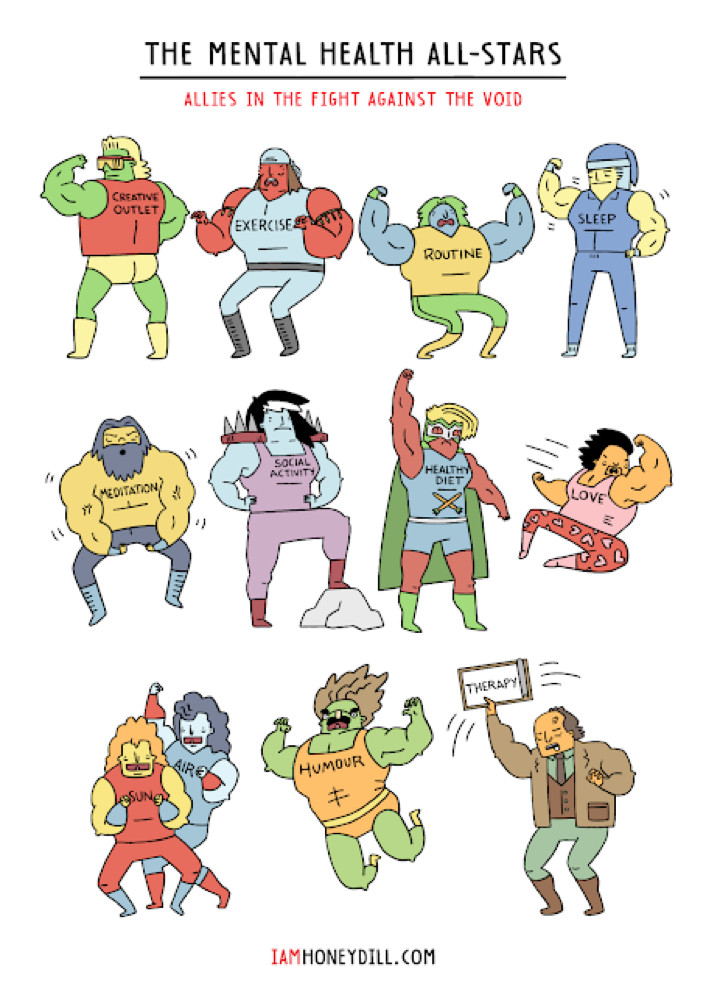
Before we discussed the first six of the Mental Health All-Stars. In this post, we'll continue exploring these areas of self-care that give us the armor to stand up against depression and anxiety.
7. Healthy Diet
Nutrition plays SUCH an important role in mental health and wellness. In many ways, the food you eat influences the function of your brain and mood. There is lots of research showing that a healthy diet is just as important to mental health as it is to physical health. A low-quality diet that's high in refined sugars can really impact depression and anxiety. To reap the most benefits of nutrition for mental health, focus on a balanced diet that is nutrient-dense. Research shows that diets high in these vitamins pack the biggest mental health punch: B Vitamins, Iron, Zinc, and Omega-3s. If you feel you may be nutrient deficient, be sure to have a chat with your primary care doctor! It's helpful to approach mental health care from all angles. Don't underestimate the importance of nutrition and a healthy diet when considering your mental health care.
8. Love
I love love! Love literally creates a chemical reaction in our brain that releases oxytocin, which is a feel-good hormone that lifts our mood and creates a feeling of attachment. Loving and stable relationships can create a strong emotional support system for those suffering with depression and anxiety. Love comes in all forms. We have love for our family, our friends, our partners, and our pets. Making it a point to create love in your life, in any form, is essential to emotional well-being. Spending time with people with whom we have quality, loving relationships can help us feel more secure and not so alone. However, depression and anxiety have a way of making us isolate. It's important to take things little by little--cuddle a pet, text a friend, or listen to a song that reminds you of your partner. Nurturing those healthy relationships and bonds reminds us of the loving supports that we have in our lives, and sets our brains up for mood elevations.
9. Sun and Air
It's amazing what a little time in nature can do for our mental health! Walking has been shown to be effective in reducing anxiety and depression. Evidence also points to nature being an added benefit to those results! Being in the sun and getting fresh air helps to calm our minds, leading to psychical changes in blood pressure and heart rate. You don't have to go hiking or mountain biking to get these health benefits. Just spend some time outdoors for a few minutes each day to reap the benefits. Bonus points if you can add a little meditation into your nature time.
10. Humor
Laughter helps. When you can share a good joke with a friend, watch a funny movie, or find a hilarious meme, life feels just a little lighter, if only for a moment. Laughter releases endorphins in our brains and eases distressing emotions. One of my favorite self-care activities is to watch funny YouTube videos. It helps me relax and makes me laugh! Find something that makes you smile and adds a little humor to your life. It won't make you "un-depressed," but it will help to lighten your day, just a little bit.
11. Therapy
If you're struggling with mental health concerns--be it depression, anxiety, issues with past trauma, relationship concerns, insecurities, low self-esteem, addiction, etc, therapy helps. It's so powerful to share your story with a trained, trusted professional. In therapy, you'll be given a safe space to explore your thoughts and feelings, and will be given the tools you need to be successful in reaching your goals for your mental health. Therapy can be one of the most powerful tools at your disposal to overcome challenges and grow from your experiences. It's important to make sure you have a good fit with the therapist you're working with. Research shows that one of the biggest factors in determining the success of therapy is the therapeutic relationship. How will you know if you've found a good fit? You'll know if you feel comfortable and safe with your therapist, and feel that you can trust them to give you open and honest feedback regarding your concerns. You'll feel understood and validated. You might not always like what they say (sometimes therapists say things that are not easy for us to hear), but you'll always feel respected and like your goals and needs are at the heart of the session. If you have questions about what therapy is like, visit my FAQ page: FAQ.
I hope this list has been helpful in exploring some tools to care for yourself as you bravely do great things despite your depression and anxiety. It's important to remember that none of these things will be a complete and total answer all by themselves. Your mental health concerns are real and valid, and deserve ongoing treatment and care. However, these tools are absolutely necessary to help you in your fight to win the battle. You've got this. And you're strong.
Take good care of yourself.
Written by Kayla Renteria, LPCC - mental health counselor with Renteria Counseling in Louisville, KY
I work with children, adolescents, and adults with a variety of presenting concerns. Many of my clients come to me with concerns related to anxiety, depression, relationship issues, and past trauma. My experience as a therapist has provided me the opportunity to work alongside clients from many different walks of life. My philosophy on treatment is to empower my clients through a trusting relationship, compassion for their situation, understanding that they are doing the best they can with what they have, and a good measure of humor to keep things real. I specialize in treating trauma, depression, and anxiety.
I am also trained in EMDR, a highly effective and efficient treatment modality for trauma and mood disorders. I know how uncomfortable it can be to address painful moments in the past and present. I am honored to walk alongside my clients as we work to heal the past and move forward in a healthy way.
My educational and professional experiences have provided me with the expertise to guide you, utilizing evidence-based treatment principles and an unwavering sense of compassion. I would love the opportunity to talk with you about how I can help you. When you're ready, give me a call or use this link to schedule “.
The mental health and wellness professionals that practice out of b.mindful Louisville are skilled in what they do. Each specializing in their own area and caring for their clients in their own unique way.
If you need help finding the best human helper to meet your specific needs, email us for one-on-one assistance.
*The information and resources contained on this website are for informational purposes only and are not intended to assess, diagnose, or treat any medical and/or mental health disease or condition. The use of this website does not imply nor establish any type of therapist-client relationship. Furthermore, the information obtained from this site should not be considered a substitute for a thorough medical and/or mental health evaluation by an appropriately credentialed and licensed professional.

11 ways to fight depression and anxiety (part 1)
It's difficult to find that inner-strength when depression and anxiety have their grip. Normal activities feel so much more exhausting, scary, or impossible.
I borrowed this super cute comic from iamhoneydill.com, which is an awesome webcomic if you haven't checked it out. I love this comic, and share it frequently with my clients. Depression and anxiety can be so debilitating. It sucks our energy and our motivation, it tells us we can't when we want to believe we can, and it can make us feel so, so small.
It's difficult to find that inner-strength when depression and anxiety have their grip. Normal activities feel so much more exhausting, scary, or impossible.
I find that many of my clients feel empowered when they are able to access the ways in which they can take back control of their lives, even if it's in just a small area. In this blog post, we'll go over each of these "Mental Health All Stars" to explore how you can better access tools to fight back in the battle with depression and anxiety. We'll start with half of the All Stars this week. Stay tuned for the next post to learn about the second half!
1. Creative Outlet
"Creativity takes courage" - Henri Matisse
Creativity has a way of propelling emotions and experiences forward that are too difficult to be expressed in words. Research shows that creative outlets, like painting, drawing, music, and writing, help people manage their negative emotions in a productive way. If you're an artist, you'll know what I'm talking about--there's something very special about expressing yourself creatively that just can't be done with words. If you've never tried your hand at a creative outlet, or feel like you won't be any good, remember that healing through creativity is not about the output, it's about the process. Whatever brush strokes you take or chord progression you form doesn't really matter in the end. The important part is the creation of it. The expression of what can't be said. The emotional process. Give it a try! Buy a cheap canvas and some acrylic paints at Target, turn on some music, and see what happens. You could also try a musical instrument, a drawing pad, modeling clay, or an adult coloring book if that's more your style. There are endless ways to be creative and none of them have to be fancy!
2. Exercise
Yes. Exercise is on this list. I know. I dread it, too. Some of you may love it, though, and good for you! Exercise releases chemicals like endorphins and serotonin that improve your mood. Making exercise a habit in your day to day life can ensure that you're brain is juicing out those feel good chemicals on the reg. Fear not: you don't have to run a marathon in order to get the mental health benefits of exercise. Studies show that the sweet spot is about 30 minutes of exercise, 3-5x per week. That's doable, right? If you're new to exercise, take it slow: try some yoga, or take Spot for a stroll in the park. Slowly build yourself up to a routine that works for you. Speaking of routine..
3. Routine
We all like to know what to expect. Especially for those with anxiety, having a routine in place can help to reduce stress levels. It can be incredibly overwhelming to feel like we have a million things to do, and a ton of stuff running through our mind all at once. Having a routine helps us to organize ourselves a bit, and to prioritize our lives. It can feel like a relief to know what's coming and not feel like everything is happening all at once. Routine gives us a sense of control. In addition to reducing our stress, routines also help us hold ourselves accountable for building healthy habits. When we commit to a routine, we commit to taking certain actions daily for the betterment of our health. Like all things, start out slow. Choose one healthy habit that you'd like to cultivate in your life. Maybe you want to drink more green tea (hello great start to your day!), or perhaps you want to journal each night before bed. Commit to something that's doable for you, and slowly build that habit up. Once you've mastered that habit, add in a new habit. Maybe something a bit more challenging, but not unattainable. Think about the things you want to accomplish each day, and a goal that will help you get there. You've got this.
4. Sleep
Good sleep hygiene is sooooo important for mental health. I can't tell you how many clients I work with--adolescents and adults--who don't get enough sleep every night. You know the feeling, don't you? Groggy, irritable, barely alive. Your only salvation is a Venti Americano! I know that feeling, too, and it makes life really hard. Lack of sleep makes us more vulnerable to anxiety and stress, and negatively impacts our mood. It works both ways too: when we're stressed and anxious, falling asleep is hard! To practice good sleep hygiene, try the following:
- Limit your screen time at bedtime. Try putting your phone on your dresser on the other side of the room, so you're not tempted. At the very least, make sure you're dimming your screen if you can't seem to part with it.
-Have some tea, take a bath...get cozy! Try priming yourself for bedtime by making yourself as comfortable as possible
-Try some relaxation exercises. Deep breathing, yoga, or visual imagery are all great methods to try as you lie in bed waiting for the ZZZZs to come.
-If you don't fall asleep, get up. Don't lie in bed awake. That makes falling asleep that much harder. Instead, get up. Read a book, watch a show, clean the kitchen, and wait to feel tired. Once you feel that sleepiness coming on, head back to bed.
Sleep doesn't always come easy, but with these tips, you'll be snoozing sooner!
5. Meditation
Have you ever tried meditation? It's definitely a buzz word these days, and for good reason! Meditation is a practice to obtain a mental clarity and a mindful state. It's a skill--so it takes practice. But even in the beginning, you'll find that the benefits of meditation are huge. Research shows that meditation actually changes your brain and the way your mind responds to stress and anxiety. For some people, it can work as effectively as medication (according to this study )! Like all things in this list, take it slow to start out (remember our routine building discussion?). The experts say that meditation works best when we practice it consistently--that means every day. Start out with just five minutes a day, first thing in the morning. You'll be amazed at how good it feels to set yourself up for a good day in this way. I really love the meditation apps out there. Two of my faves are Headspace and the Calm app. Both of these have premium subscriptions, but the free ones offer access to great beginner sessions to introduce you to the practice of meditation. Also, there are TONS of free meditations on YouTube. Can't sleep? Search "meditation for sleep." Feeling burnt out at work? Search "meditation for work." Have only 3 minutes? Try "3 minute meditation." Literally anything can be found with the magic of YouTube. Give it a shot, I promise you'll find some benefit from the practice. And hang in there--like any skill, this one takes time to learn. But with practice, you'll find it becomes easier and easier to center yourself.
6. Social Activity
Socialization is so key to our mental health! It can be tough, though, when depression and anxiety hits. When we get a text to come hang out, but we just feel like staying in bed. Or if we so wish that we'd get a text to come hang out, but our phone stays silent. Either one of those really hurts. It can be hard to put ourselves out there. If you struggle with finding the mental and emotional energy to make socialization a regular part of your life, try making a deal with yourself. You'll hang out for 30 minutes, or an hour. If you feel like going home after that, no big deal. Let yourself off the hook. Sometimes you might find that you're feeling better when you're out with other people. Other times you might feel drained and ready to leave. Either way is perfectly okay--you have to meet yourself where you are. Surround yourself with people who understand, and don't let anyone make you feel bad for taking care of yourself. If you're struggling with loneliness and meeting people to hang out with, there are a few options. It can be scary to put yourself out there, but there are a lot of supportive outlets for people looking to connect. Joining a support group is a great way to find people who are dealing with similar concerns. Often, my clients find that these groups allow them to feel understood, like someone else really gets it. Here in Louisville and Southern Indiana, we have the Depression and Bipolar Support Alliance, which is a great group for people with anxiety and depression seeking help from folks who understand. In addition to support groups, there's also this really cool website called Meetup, where you can connect with people in your age group that share a common interest with you. There are plenty to choose from--book clubs, rock climbing meetups, groups for people just moving to the area. Finding healthy ways to connect with others is important to our wellbeing. We're social creatures, afterall. Having a healthy support system and feeling like we belong improves our mood. Taking action is one way to be an advocate for our own metal health.
That's all for today! Tune back in for Part Two of this blog post, where we'll explore the remainder of our friends the Mental Health All Stars!
Written by Kayla Renteria, LPCC - mental health counselor with Renteria Counseling in Louisville, KY
I work with children, adolescents, and adults with a variety of presenting concerns. Many of my clients come to me with concerns related to anxiety, depression, relationship issues, and past trauma. My experience as a therapist has provided me the opportunity to work alongside clients from many different walks of life. My philosophy on treatment is to empower my clients through a trusting relationship, compassion for their situation, understanding that they are doing the best they can with what they have, and a good measure of humor to keep things real. I specialize in treating trauma, depression, and anxiety.
I am also trained in EMDR, a highly effective and efficient treatment modality for trauma and mood disorders. I know how uncomfortable it can be to address painful moments in the past and present. I am honored to walk alongside my clients as we work to heal the past and move forward in a healthy way.
My educational and professional experiences have provided me with the expertise to guide you, utilizing evidence-based treatment principles and an unwavering sense of compassion. I would love the opportunity to talk with you about how I can help you. When you're ready, give me a call or use this link to schedule “.
The mental health and wellness professionals that practice out of b.mindful Louisville are skilled in what they do. Each specializing in their own area and caring for their clients in their own unique way.
If you need help finding the best human helper to meet your specific needs, email us for one-on-one assistance.
*The information and resources contained on this website are for informational purposes only and are not intended to assess, diagnose, or treat any medical and/or mental health disease or condition. The use of this website does not imply nor establish any type of therapist-client relationship. Furthermore, the information obtained from this site should not be considered a substitute for a thorough medical and/or mental health evaluation by an appropriately credentialed and licensed professional.

Navigating Romantic Relationships With A Mental Health Diagnosis
Relationships are complicated. Mental health issues are complex. Put the two together, and things can get real, really quick. Since we are nearing Valentine's Day, let's talk about juggling dating and romance--while navigating your own mental health.

Relationships are complicated. Mental health issues are complex. Put the two together, and things can get real, really quick. Since we are nearing Valentine's Day, let's talk about juggling dating and romance--while navigating your own mental health.
Mental Health Issues Make Dating More Stressful
Dating is stressful for everyone. Having jitters before a first date, or wondering when to text is nerve-racking. For those who suffer with depression and anxiety, you might go into over-thinking mode, wondering if you screwed up, or feeling like you're not good enough. Mental health conditions can turn the volume of dating stress up to 10. Having an arsenal of effective coping tools is key. Finding relaxation and grounding techniques that work for you can help offset anxiety that is worsened by putting yourself out there.
Deciding If You're Ready to Date
Struggling with mental health issues is no small feat. It can be a daily struggle. Adding intimacy and a relationship to this can sometimes be very difficult. If you're wondering if you're ready to date or start a relationship, a good place to check in with yourself would be your reason for dating. Understand that beginning a relationship will not "fix" the problems that you are struggling with. Mental health issues like depression, anxiety, or trauma have deeper issues, and although intimate connections with others temporarily lift the emotions of these disorders, the underlying causes remain. Managing your condition takes time and effort, and while partners and loved ones are often supportive, the work is yours and yours alone.
Understanding What You Have to Offer
When I talk with my clients about their desire to date, they are sometimes worried about what they have to offer in a new relationship. Focus on the qualities that are important to you in relationships, and ways that you can strengthen those values within yourself.
Knowing Your Boundaries
Boundaries are important in all relationships. Before jumping into the dating world, take time to consider your boundaries. Do you need alone time more frequently that your potential partner does? Are you ready for sex? Do you need to clarify your communication style, or your communication needs? Can you be more clear about commitment and what you want? Often, when we are eager to connect with others, we let our boundaries slide. Boundaries are what keep relationships healthy. They protect us and our relationships. Understand your boundaries and be ready to communicate them upfront and early on.
When to Share Your Diagnosis
Many people experience reluctance about sharing their diagnosis with others, particularly with a potential dating partner. There are lots of reasons for this--the stigma surrounding mental health issues, fear of turning off the other person, or fear of the other person misunderstanding what all the diagnosis means. If you're dating and thinking of committing to a relationship, it's important to share information with your partner. This information will be key to your partner's understanding if you're having an episode, and will also help them to know what you need from them in these moments. However, you don't have to lay it all out on the first date. Wait until you see if you're compatible with this person, and if they are someone that you trust before sharing.
How to Share Your Diagnosis
It's best to choose a time when you are not in an acute episode--when you can think and express yourself most clearly, and are generally stable. Let your partner know that you have something you want to share with them that will help them understand you more. Be prepared to answer their questions, if you feel comfortable, and perhaps bring some books or links to websites that you feel are informative about your diagnosis. Give your partner time to digest this information. Learning that someone you care about is struggling with their mental health is difficult. They may need time to process.
Beware of Unhealthy Patterns
Understand that mental health issues are a completely separate thing from patterns of abuse in relationships. Having a mental illness is not an excuse for abusive behavior. This article by the National Domestic Violence Hotline offers key points in understanding the difference.
Know Your Worth
Above all, know that you are worthy of a partner who is understanding and accepting of your struggles. Remember that you deserve a healthy relationship, regardless of the status of your mental health.
Written by Kayla Renteria, LPCC - mental health counselor with Renteria Counseling in Louisville, KY
I work with children, adolescents, and adults with a variety of presenting concerns. Many of my clients come to me with concerns related to anxiety, depression, relationship issues, and past trauma. My experience as a therapist has provided me the opportunity to work alongside clients from many different walks of life. My philosophy on treatment is to empower my clients through a trusting relationship, compassion for their situation, understanding that they are doing the best they can with what they have, and a good measure of humor to keep things real. I specialize in treating trauma, depression, and anxiety.
I am also trained in EMDR, a highly effective and efficient treatment modality for trauma and mood disorders. I know how uncomfortable it can be to address painful moments in the past and present. I am honored to walk alongside my clients as we work to heal the past and move forward in a healthy way.
My educational and professional experiences have provided me with the expertise to guide you, utilizing evidence-based treatment principles and an unwavering sense of compassion. I would love the opportunity to talk with you about how I can help you. When you're ready, give me a call or use this link to schedule “.
The mental health and wellness professionals that practice out of b.mindful Louisville are skilled in what they do. Each specializing in their own area and caring for their clients in their own unique way.
If you need help finding the best human helper to meet your specific needs, email us for one-on-one assistance.
*The information and resources contained on this website are for informational purposes only and are not intended to assess, diagnose, or treat any medical and/or mental health disease or condition. The use of this website does not imply nor establish any type of therapist-client relationship. Furthermore, the information obtained from this site should not be considered a substitute for a thorough medical and/or mental health evaluation by an appropriately credentialed and licensed professional.

Counseling Should and Shouldn't Be
We’ve all seen the word, or variations of the word within the mental health scene. We know someone who has been in counseling or maybe we’ve had first-hand experience with it. But I don’t think a lot of people know what should and shouldn’t happen within the counseling hour, and honestly, I don’t think that’s their fault. The nature of mental health client/counselor confidentiality and societies viewpoints on this field plays a big role in this “unknown world of the counseling hour”.
coun·sel·ing
/ˈkouns(ə)liNG/
noun
1. the provision of assistance and guidance in resolving personal, social, or psychological problems and difficulties, especially by a professional.
We’ve all seen the word, or variations of the word within the mental health scene. We know someone who has been in counseling or maybe we’ve had first-hand experience with it. But I don’t think a lot of people know what should and shouldn’t happen within the counseling hour, and honestly, I don’t think that’s their fault. The nature of mental health client/counselor confidentiality and societies viewpoints on this field plays a big role in this “unknown world of the counseling hour”.
But I am here to share 7 tips of what you “should” and “shouldn’t” expect when entering therapy with a new counselor.
1. You SHOULDN’T expect it to be like your typical medical physicians’ checkup.
It’s easy to associate mental health with your body and how to take care of your mental health with how you take care of your body. But it’s not quite the same. I mean there are some similarities; you make an appointment, drive to that appointment, enter the waiting room, fill out some paperwork, browse through a magazine and then someone calls your name (probably mispronouncing it) but that is where the similarities stop. 1) hopefully the physical décor within the office is slightly less sterile than your physician’s office and 2) that your counselor doesn’t say “okay everything looks good see you back next year” at the end of your appointment. Most people don’t go to their medical physician more than 5 times a year, but most people are seeing their therapist more than 20 times a year. If you enter counseling you are going to be expected to attend weekly, or bi weekly sessions for an estimated 3 months to a year or more.
2. You SHOULD be motivated and invested in your treatment.
One of the most important things you should expect is to be motivated and invested in your counseling process. There is a common myth out there that entering counseling makes one “too focused on themselves”. And it’s true, counseling does involve reflecting on your thoughts, feelings, choices, and relationships and increasing your self-awareness. But the point of all that increased awareness is to allow you to make more informed choices about what’s important to you, how you get your needs met in the world, and how you impact other people. While it does take a certain amount of self-reflection, it often results in you being more attuned to and present with other people in your life. Taking care of yourself actually frees you up to be a better friend, partner, parent, and colleague.
3. You SHOULD like and trust your counselor.
Sounds like a big ole “DUH”. But you will not believe the number of people I have met with that have described their past counselor as “totally opposite than me” or someone who “didn’t get me” or “had totally opposing beliefs as me”. Suggestion to the masses, do your research prior to entering counseling! If you are someone who often cusses and is abrasive, you might not want to pick the counselor who is highly professional and uses sophisticated language throughout their site. Pick someone who is more in line with your personality and wants for your future.
And even if you do your research beforehand and figure out you aren’t vibing after a few sessions, that’s okay! Let your counselor know this, and who knows there might be something that can be done to make you feel more comfortable or maybe there isn’t. But the good thing to note is that there are thousands of human helpers in your city and your counselor would be happy to provide you with a referral to a better fitting therapist.
4. You SHOULDN’T expect it to be easy.
Unfortunately, there is no “magic pill” and counselors don’t have wands that we wave around to solve your problems (because trust me, if I did, I would be waving it around like crazy and happily be out of a job). Counselors won’t tell you to go home and “rest, ice, compress and elevate” to heal your broken heart after a break up, or to assist in the grieving process after a loss of a loved one. They will tell you to keep coming back and that the counseling process will assist you in feeling more connected, more capable of dealing with the challenges of adulthood, and more empowered to make decisions and follow through on plans that reflect your renewed sense of self and purpose.
5. You SHOULD experience some feelings of discomfort.
As is the case with most things in life, there are both benefits and risks while participating in counseling. Counseling may improve your ability to relate with others, provide a clearer understanding of yourself, your values, and your goals, and it often helps relieve stress immediately. Along with these benefits, counseling will also involve discussing the unpleasant parts of your life, and you may experience uncomfortable feelings during these moments. But remember that using the awareness of one’s pain can aid the healing process and result in better relationships with yourself and others.
6. You SHOULDN’T expect your counselor to fix your problems.
The goal of counseling is not for someone else to “fix” your problems. Counselors are here to help you to identify those concerns and to set new goals for yourself. In therapy you will solve problems by working collaboratively with your counselor to explore your feelings, thoughts, and behaviors. In doing so, you can explore all your options and make a decision as to how to best achieve your goals. In the end, YOU know yourself the best, therefore YOU are the best one to “fix” your problems!
7. You SHOULD experience personal growth.
A lot of people enter counseling with the goals to “feel less” of something or “more of” something else, but the overall goal for everyone’s treatment should be personal growth. At the end of the day all we have control of is our own thoughts and actions. Therefore, more time needs to be spent on developing a sturdy ground for our internal and external selves to stand on. So, when shit does hit the fan and we are needing to “feel less of” this or “more of that” we are able to sort through our tool box and get our needs met with the assistance of a counselor, and eventually alone.
Written by: Shannon Gonter, LPCC of Therapy by Shannon in Louisville, KY
I specialize in working with men and young adults. I am passionate about my career and want to work with you to create positive change. I also strive to create a counseling environment where men and young adults can relate, feel heard, and find new solutions to their negative patterns. Some issues that I most commonly work with are stress, relationship issues, difficulty saying “no” to others, difficulties recognizing emotions and emotionally connecting to others, anger, and intimacy issues, among others.
The mental health and wellness professionals that practice out of b.mindful Louisville are skilled in what they do. Each specializing in their own area and caring for their clients in their own unique way.
If you need help finding the best human helper to meet your specific needs, email us for one-on-one assistance.
The information and resources contained on this website are for informational purposes only and are not intended to assess, diagnose, or treat any medical and/or mental health disease or condition. The use of this website does not imply nor establish any type of therapist-client relationship. Furthermore, the information obtained from this site should not be considered a substitute for a thorough medical and/or mental health evaluation by an appropriately credentialed and licensed professional.