
Managing Emotions When The Holidays Are Nearing
The Holidays are drawing near. For many of us, this can be extremely stressful. At a time that is expected to be filled with joy, many struggle with feelings of grief and loss, being overwhelmed by changes in routine, being around unsupportive family, and many other issues that pop up this time of year.
The Holidays are drawing near. For many of us, this can be extremely stressful. At a time that is expected to be filled with joy, many struggle with feelings of grief and loss, being overwhelmed by changes in routine, being around unsupportive family, and many other issues that pop up this time of year.
Because this time of year can be difficult, it's important to put in place some self-care strategies to help cope as you navigate through the holidays in a healthy way.
1. Set realistic expectations.
If attending three holiday parties in one weekend seems exhausting, give yourself permission to only go to one or two (or none). If planning the holiday meal is too overwhelming, ask for help. Create a reasonable budget for gifts, and don't exceed it (even if that budget is $0.00). Keeping your expectations for the season realistic will allow you to resist the pressures that the season can bring.
2. It's okay to feel sad or lonely.
Feelings of sadness, loneliness, or grief don't suddenly go away because of the holidays. In fact, these feelings are often intensified during this time of the year. There is room for these feelings during the holidays. You can choose to express these feelings or not--it's absolutely up to you. But give yourself permission to have these feelings and to nurture them in whatever way feels right to you.
3. Eat and drink in moderation.
Holidays often lead to excess consumption of food and alcohol. Monitoring this is important. Avoid over consumption if you are feeling down. It often only increases our feelings of distress.
4. Don't isolate
Take time for yourself if you need it! But don't isolate yourself. Spend time with people that are supportive and understanding. Don't be afraid to reach out to community service agencies if you need additional support.
5. Be aware of triggers
For some, the holidays may bring triggers of grief or trauma. Be aware of these, and have a plan to cope. Is there a supportive friend that can be with you or be available for a call? Do you have effective coping or relaxation skills to regulate yourself? Do you have an exit strategy if you need to leave a gathering? Having a plan in place can make you feel more prepared for the challenges the day may bring.
6. Change things up!
Try something new for the holiday season. Volunteer, spend the day with friends instead of family, or take a small trip. You can spend the holidays in whatever way feels good to you, traditions be damned!
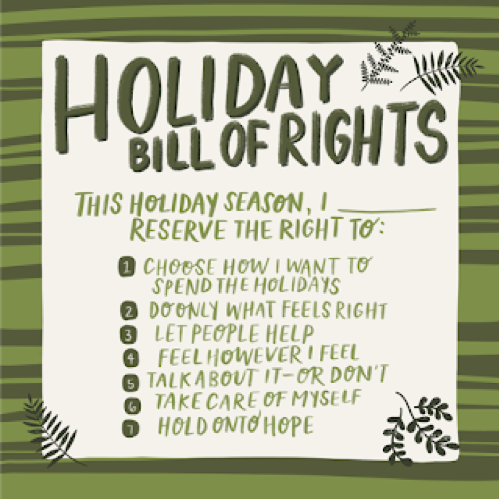
7. Follow the Holiday Bill of Rights
Captured in the image above, the Holiday Bill of Rights is a brief but helpful guideline to remembering your boundaries during the holiday season. Reflect on the ways that you can honor yourself and your feelings during the season.
May we all navigate the holidays mindfully and honor our needs.
Written by Kayla Renteria, LPCC - mental health counselor with Renteria Counseling in Louisville, KY

I work with children, adolescents, and adults with a variety of presenting concerns. Many of my clients come to me with concerns related to anxiety, depression, relationship issues, and past trauma. My experience as a therapist has provided me the opportunity to work alongside clients from many different walks of life. My philosophy on treatment is to empower my clients through a trusting relationship, compassion for their situation, understanding that they are doing the best they can with what they have, and a good measure of humor to keep things real. I specialize in treating trauma, depression, and anxiety.
I am also trained in EMDR, a highly effective and efficient treatment modality for trauma and mood disorders. I know how uncomfortable it can be to address painful moments in the past and present. I am honored to walk alongside my clients as we work to heal the past and move forward in a healthy way.
My educational and professional experiences have provided me with the expertise to guide you, utilizing evidence-based treatment principles and an unwavering sense of compassion. I would love the opportunity to talk with you about how I can help you. When you're ready, give me a call or use this link to schedule “.
The mental health and wellness professionals that practice out of b.mindful Louisville are skilled in what they do. Each specializing in their own area and caring for their clients in their own unique way.
If you need help finding the best human helper to meet your specific needs, email us for one-on-one assistance.
*The information and resources contained on this website are for informational purposes only and are not intended to assess, diagnose, or treat any medical and/or mental health disease or condition. The use of this website does not imply nor establish any type of therapist-client relationship. Furthermore, the information obtained from this site should not be considered a substitute for a thorough medical and/or mental health evaluation by an appropriately credentialed and licensed professional.

HOW TO NAME SHAME AND THEN LET IT GO
Lots and lots of emotions out there, like lots. And they fall all over the map from positive to neutral to negative (with some fluctuating on severity dependent on the given situation). My personal opinion (and a popular one) on emotions is that not a lot of emotions are inherently “bad” or “negative” to feel, it’s what we do with that emotion that can be “bad” or “negative”. But there is an exception to this rule, and I will say, with confidence, that shame can almost always be classified as a “bad” emotion.
Lots and lots of emotions out there, like lots. And they fall all over the map from positive to neutral to negative (with some fluctuating on severity dependent on the given situation). My personal opinion (and a popular one) on emotions is that not a lot of emotions are inherently “bad” or “negative” to feel, it’s what we do with that emotion that can be “bad” or “negative”. But there is an exception to this rule, and I will say, with confidence, that shame can almost always be classified as a “bad” emotion.
Now what is shame. We hear it from time to time but honestly a lot of people confuse shame with guilt. And it can get tricky to differentiate between the two sometimes. “What is shame?” or “What’s the difference between shame and guilt?” is actually the top Googled items when it comes to shame. So, let’s clear some things up before continuing on…
Guilt is “feelings of deserving blame especially for imagined offenses or from a sense of inadequacy”
Gershen Kaufman stated that, "Shame is the most disturbing experience individuals ever have about themselves; no other emotion feels more deeply disturbing because in the moment of shame the self feels wounded from within."
Therefore, the difference is that “Shame is a focus on self, guilt is a focus on behavior. Shame is, "I am bad." Guilt is, "I did something bad." – Brene Brown
So, from here on out when I talk about shame, I'm not talking about anyone actually doing anything wrong. I am talking about the feelings, and thoughts that we are somehow wrong, defective, inadequate, not good enough, or not strong enough.
To break it down a little more, lets walk through the some of the most common ways experience shame.
WITHDRAWING
Seems to be the most common response to shame. When you feel rejected or humiliated, you may begin to isolate yourself from connecting with others to avoid running into this feeling again. In the moment this may look like slumping your posture, avoiding eye contact or lowering your head. All of this makes sense and at times is a natural protective factor response to humiliation, but this eventually turns into a cycle and you may start to avoid going out with friends or often feeling “checked out”.
ATTACKING YOURSELF
No hidden psychological meaning here. This is what it says. Attacking yourself. The inner dialogue that we each have turns negative and says things like “I am stupid, I lack value, I am ugly, I am defective, I am unworthy etc.” After some time, these thoughts infect your actions and you start presenting yourself outwardly as if you are stupid, lack value or are ugly.
LACK OF BALANCE
Avoidance: Don’t like experiencing all these negative feelings? Simple solution seems to just turn them off then, right? Unfortunately, emotions don’t work like this – they don’t have an off switch. They may be turned off/ignored/repressed by you, but they are still very much a part of you and inside you. Since you are not actively engaging with them, they show up in your life through excessive drinking, drug usage, spending etc.
Doing More Of: So, let’s say you are feeling shame around your sexual activity and you have a thought that if you just do it more, and get more comfortable with it, then the shame with dissipate. Now this would work (if shame wasn’t in the picture) but shame is in the picture for you, so this strategy doesn’t work. In the end you may become more promiscuous and therefore building up your shame opposed to working to lower it.
Over Doing: Maybe you notice that you often over do, over give, over share, over strive on things that you are proud of in order to ignore those situations that bring discomfort into your life.
ATTACKING OTHERS
Appears to be a common sign of shame and comes off in varying degrees. Maybe it is putting others down, demeaning them, being cruel or even emotional and physical abuse. These are often played out to show a dominance or power over someone else (since you can’t get a handle on or take power over your feelings of shame).
SO NOW WHAT? DON’T WORRY I WON’T LEAVE YOU HANGING.
The following steps can assist you in breaking the cycle of shame.
STEP 1: NAME IT!
Think back and determine when you started feeling this way
Assess how your body experiences shame
Process those feelings (either alone or with someone else)
By doing this your relationship with shame will change and it will start to play a less powerful role in your life.
STEP 2: SET REALISTIC EXPECTATIONS
Recognize your physical, emotional and cognitive restrictions and plan accordingly. Though it is good to do your own research and read blogs, you may not find relief there. Given that shame starts in infancy and gets built on throughout our lives, there is usually a lot of items to dig through and most people see best results with assistance from a mental health professional.
STEP 3: TELL THE WORLD!
Not really. I mean you can if you want, but what I mean is talk to someone who will understand and not cast judgement on you. In the end it is our inner thoughts that are keeping us locked in the room with shame, so why not allow someone else into the room to assist in looking at it from a different light. This will often allow you to understand that we judge ourselves on a harsher scale than others judge us and eventually release the shame from the body.
STEP 4: CHANGE YOUR INNER VOICES
Adding onto the thought that we judge ourselves harsher than others judge us, try to reframe your inner voice. Think about it in terms of “would I say this to someone else” (and if not, don’t say it to yourself). Most of the time you wouldn’t, so let’s try to be kind to ourselves and shift your inner dialogue.
I understand that the title of the blog (How To Name Shame And Then Let It Go) may be misleading to some and that “if I name it, then it’ll go away and won’t come back”, but that isn’t the case with shame. Working through the shame in our lives takes time, requires active effort (on your end and often others) and hard work (months, maybe years…). So, you may think “okay then, why not name the blog something else.” Thought about it (obviously), but I just kept coming back to the process of letting go. Often change is difficult, scary and intimidating and throughout the process it may make you feel vulnerable or exposed. Involved in this process is letting go of those maladaptive behaviors that covered your shame and eventually replacing them with different, more positive and adaptive skills therefore lowering the exposed necked feelings.
Written by: Shannon Gonter, LPCC of Therapy by Shannon in Louisville, KY

I specialize in working with men and young adults. I am passionate about my career and want to work with you to create positive change. I also strive to create a counseling environment where men and young adults can relate, feel heard, and find new solutions to their negative patterns. Some issues that I most commonly work with are stress, relationship issues, difficulty saying “no” to others, difficulties recognizing emotions and emotionally connecting to others, anger, and intimacy issues, among others.
The mental health and wellness professionals that practice out of b.mindful Louisville are skilled in what they do. Each specializing in their own area and caring for their clients in their own unique way.
If you need help finding the best human helper to meet your specific needs, email us for one-on-one assistance.
The information and resources contained on this website are for informational purposes only and are not intended to assess, diagnose, or treat any medical and/or mental health disease or condition. The use of this website does not imply nor establish any type of therapist-client relationship. Furthermore, the information obtained from this site should not be considered a substitute for a thorough medical and/or mental health evaluation by an appropriately credentialed and licensed professional.

5 Strategies to Calm Your Anxiety Quickly
When you live with an anxiety disorder, any moment can become one that creates a slow-rising panic within you. Life is normal one second and the next, you feel your chest tighten and your heart begin to race.

When you live with an anxiety disorder, any moment can become one that creates a slow-rising panic within you. Life is normal one second and the next, you feel your chest tighten and your heart begin to race. You may begin to hyper-focus on future events and find yourself getting lost in “what-ifs.”
To make matters worse, you may then begin to berate yourself for allowing the panic to get the best of you and begin to believe that all of those what-ifs are indisputable facts.
Luckily there are many powerful tools and techniques you can use to manage your anxiety effectively.
Breathe Deeply
The minute you feel a panic attack coming on, the first thing to do is stop and gain control of your breath. Deep, slow breathing sends a signal to our brains that everything is safe in our environment. Controlled breathing is one of the most powerful ways to activate your body’s relaxation response. It will take your mind and body out of “fight or flight” mode and put it instantly into a calm and relaxed state.
Accept That You are Anxious
It’s important to always remember that anxiety is “just a feeling.” And like all feelings, it can go as quickly as it came. You are having an emotional reaction to a string of thoughts. Accept your anxiety because trying to pretend it’s not happening will only make matters worse.
Let’s be clear – by accepting your anxiety, you are not resigning yourself to a life of eternal misery. You are not throwing in the towel and trying to suddenly like your anxiety. Nope. You are simply living a more mindful existence, being in the moment, and accepting whatever is in that moment with you.
Your Emotions Cannot Kill You
One of the most frightening things about a panic attack is the feeling that you are having a heart attack. But you aren’t. Your brain can and will play tricks on you, trying to get you to believe that you are in physical danger. But the truth is, you are not in physical danger. You are having an episode based on emotions and it will pass. Remind yourself of that as many times as you need to.
Question Your Thoughts
When your panic attack begins, your mind begins to throw out all sorts of outlandish ideas at you, hoping some of them stick. These thoughts are intended to keep the panic attack going.
Before you take any of these thoughts as reality and truth, question them. For instance, if your mind throws things out like, “No one here likes me. I am for sure going to screw this up. I probably left the stove on. And I’ll no doubt get stuck in bad traffic on the way home and maybe even get a flat so I will then be stranded, and on and on and on…”
Questions these ideas. Are you TRULY not liked by everyone around you? Most likely not. Are you really going to screw up? Probably not. Traffic? Well, maybe but a flat tire? Chances are no.
Always question your thoughts. You will usually find the majority aren’t very realistic or probable.
Visualize
Picture somewhere serene that brings you peace and calm. Maybe this is your grandparents’ old house or a lake you’ve visited before. Maybe it’s that fantastic beachfront condo from your last vacation. Just picture it in your mind’s eye and really put yourself there. See it, smell it, feel it. Feel how calm it feels to be in this space that is perfectly comforting and safe.
Use these techniques the next time you experience an anxiety attack. They should help you feel much calmer much sooner.
If you would like to explore treatment options for your anxiety, please get in touch with me. I’d would be more than happy to discuss how I may be able to help.
SOURCES:
Blog written by Tomeika S. Leavell, LCSW of Louisville, KY

Tomeika S. Leavell. She is a licensed clinical social worker. She is in private practice with Leavell Counseling, LLC in Louisville, Kentucky. She holds a license in the state of Kentucky at the present time, and temporarily holds on in the state of Indiana with the goal of permanent licensure soon. She is committed to providing quality counseling services to individuals desiring growth and change and she looks forward to supporting clients in their process of growth and change. She currently provides therapy sessions via a secure online platform for clients throughout the state of KY. You can follow her on Facebook and Instagram @leavellcounselingllc, and learn more about her at https://leavellcounselingllc.com
The mental health and wellness professionals that practice out of b.mindful Louisville are skilled in what they do. Each specializing in their own area and caring for their clients in their own unique way.
If you need help finding the best human helper to meet your specific needs, email us for one-on-one assistance.
*The information and resources contained on this website are for informational purposes only and are not intended to assess, diagnose, or treat any medical and/or mental health disease or condition. The use of this website does not imply nor establish any type of therapist-client relationship. Furthermore, the information obtained from this site should not be considered a substitute for a thorough medical and/or mental health evaluation by an appropriately credentialed and licensed professional.

Are the “5 Stages of Grief” Real?
Denial, anger, bargaining, depression, and acceptance: these are the very well-known five stages of grief, as postulated by Swiss psychiatrist Elisabeth Kübler-Ross in her 1969 book On Death and Dying. At the time of the book’s publication, very little instruction was given in medical school…

Denial, anger, bargaining, depression, and acceptance: these are the very well-known five stages of grief, as postulated by Swiss psychiatrist Elisabeth Kübler-Ross in her 1969 book On Death and Dying. At the time of the book’s publication, very little instruction was given in medical school on the subject of death and dying, which was what motivated Kübler-Ross to share her findings in her work with terminally ill patients.
Since the book’s publication, the five stages of grief have become so well-known it’s now engrained in pop culture. Despite its popularity, some people may be surprised to find out that Kübler-Ross didn’t create the stages to indicate a linear progression of grief, but rather to describe the process of the patients she observed. Before her death in 2004, Kübler-Ross noted in her book On Grief and Grieving that the five stages were not meant to be a linear and predictable progression of grief, and that she regretted that the stages had been misinterpreted.
Coinciding with Kübler-Ross’ own remarks on the five stages, there appears to be no evidence that people go through any or all of these stages, or in any particular order. As unique as is each individual and their relationships, so too is their experience with the grieving process.
Since mourning the loss of a loved one can be such a devastating experience, many who grieve yearn for a checklist, a time to look forward to when the sadness and grief will end. Unfortunately, there seems to be no definitive “end” to the grieving process; much like our own personal growth, we’re never really “done” or complete with grieving.
As we deal with life as it continues, hand in hand with the experience of mourning a loved one, we find a “new normal” – a new way to be in the world without that person in our lives.
Although grief has no particular stages, timeline or ending, it doesn’t mean that we will grieve in the same way forever. The people that we love and lose are forever engrained in our hearts and minds. Over time, the indescribable sorrow of grief morphs into a sort of bittersweet gratitude: still sad that we lost our loved one, but happy and grateful for the gift of sharing our life and time with them.
If you are struggling with grief and need support and guidance, a licensed therapist can help. Please call my office today, and let’s set up a time to talk.
Blog written by Tomeika S. Leavell, LCSW of Louisville, KY
Tomeika S. Leavell. She is a licensed clinical social worker. She is in private practice with Leavell Counseling, LLC in Louisville, Kentucky. She holds a license in the state of Kentucky at the present time, and temporarily holds on in the state of Indiana with the goal of permanent licensure soon. She is committed to providing quality counseling services to individuals desiring growth and change and she looks forward to supporting clients in their process of growth and change. She currently provides therapy sessions via a secure online platform for clients throughout the state of KY. You can follow her on Facebook and Instagram @leavellcounselingllc, and learn more about her at https://leavellcounselingllc.com
The mental health and wellness professionals that practice out of b.mindful Louisville are skilled in what they do. Each specializing in their own area and caring for their clients in their own unique way.
If you need help finding the best human helper to meet your specific needs, email us for one-on-one assistance.
*The information and resources contained on this website are for informational purposes only and are not intended to assess, diagnose, or treat any medical and/or mental health disease or condition. The use of this website does not imply nor establish any type of therapist-client relationship. Furthermore, the information obtained from this site should not be considered a substitute for a thorough medical and/or mental health evaluation by an appropriately credentialed and licensed professional.

Stress Management Techniques for People of Color Dealing with Microaggressions
Most human beings don’t get through life without dealing with their fair share of stress. But some people seem to deal with more stress than others. For instance, according to a report by the American Psychological Association (APA), both low-income…

Most human beings don’t get through life without dealing with their fair share of stress. But some people seem to deal with more stress than others. For instance, according to a report by the American Psychological Association (APA), both low-income populations and racial minorities have a greater risk of developing mental and physical health issues as a result of stress. The APA report focused on the need for raising public awareness regarding the stress-inducing implications of persistent exposure to subtle biases and micro-aggressions.
In the meantime, what can these populations do to manage their stress so they experience better health outcomes? Here are some proven stress management techniques to cope with whatever life throws at you:
Reframe
Reframing is an exercise that allows us to see the whole picture. Often times, when we experience a negative situation, we become emotionally wrapped up in the negative. But life is complex, and often there is good to be seen along with the bad. The good may be how we handled a situation or how our friends and family gave us support and strength. When we reframe, we step away from our emotions to look at the situation fully and honestly.
Relax
Stress causes tension in the body, and this tension can result in chronic health issues such as high blood pressure and chronic inflammation. It’s important to learn healthy ways to bring about relaxation. You might try tools such as progressive muscle relaxation, deep breathing, guided imagery, and biofeedback for managing your stress.
Practice Mindfulness
Over two decades of research on mindfulness shows that it is highly effective in managing stress. Mindfulness meditation involves fully focusing your awareness on the present moment. Through this practice, you accept your thoughts and feelings without judging them. There are a variety of online resources to help you get started.
Move Your Body
When we are stressed, our body experiences the “fight or flight response.” This entails a number of stress hormones to be released into our bloodstream. These hormones make our hearts beat faster and direct blood flow away from our brains and core into our arms and legs so we can remove ourselves from the perceived danger.
But for many of us, the danger is not physical but mental and emotional. And so we don’t burn through these hormones and they linger in our bodies causing damage. For instance, one of the hormones released is cortisol, which if levels are left unchecked, can cause high blood pressure and damage to the brain.
Exercise is one of the best ways to burn through these “fight or flight” chemicals. In addition, exercise helps with the production of feel-good endorphins.
These are just some of the ways you can better manage the stress in your life so it doesn’t negatively impact your health. If at the end of the day, you need more help, I encourage you to reach out to a mental health therapist who can provide you with even more stress management tools.
SOURCES:
Blog written by Tomeika S. Leavell, LCSW of Louisville, KY
Tomeika S. Leavell. She is a licensed clinical social worker. She is in private practice with Leavell Counseling, LLC in Louisville, Kentucky. She holds a license in the state of Kentucky at the present time, and temporarily holds on in the state of Indiana with the goal of permanent licensure soon. She is committed to providing quality counseling services to individuals desiring growth and change and she looks forward to supporting clients in their process of growth and change. She currently provides therapy sessions via a secure online platform for clients throughout the state of KY. You can follow her on Facebook and Instagram @leavellcounselingllc, and learn more about her at https://leavellcounselingllc.com
The mental health and wellness professionals that practice out of b.mindful Louisville are skilled in what they do. Each specializing in their own area and caring for their clients in their own unique way.
If you need help finding the best human helper to meet your specific needs, email us for one-on-one assistance.
*The information and resources contained on this website are for informational purposes only and are not intended to assess, diagnose, or treat any medical and/or mental health disease or condition. The use of this website does not imply nor establish any type of therapist-client relationship. Furthermore, the information obtained from this site should not be considered a substitute for a thorough medical and/or mental health evaluation by an appropriately credentialed and licensed professional.

5 WAYS TO STOP YOURSELF BEFORE FALLING INTO THE TRAP OF JEALOUSY
Though this is a ridiculously posed picture, I really like the stated message. In my opinion, a more accurate picture would be 6 macarons (minimum), no leaves (I mean c’mon, why are they even there?!), maybe a plate (but if we are being honest…no plate), a glass of milk (nom), a couch and Netflix (yasss). Okay, sorry, back to the message.
Though this is a ridiculously posed picture, I really like the stated message. In my opinion, a more accurate picture would be 6 macarons (minimum), no leaves (I mean c’mon, why are they even there?!), maybe a plate (but if we are being honest…no plate), a glass of milk (nom), a couch and Netflix (yasss). Okay, sorry, back to the message.

ENJOY THE LITTLE THINGS.
Well ain’t that the darn truth. But honestly, easier said than done. Enjoying the little things in a world that is so focused on the external, on the new, on the go, and on to better things even though what you have in front of you is so damn good, is really hard to do.
What makes it even harder is how difficult it is to have things in your life that you do treasure and not posting them on social media (because we all know that social media cycle oh so well).
Okay so imagine this, you’re on a wonderful vacation with your family (honestly having a blast and treasuring all the little things in life) but then you get some down time and start scrolling through your feed. You see Sally’s picture of a gift her boyfriend got her and how lucky she is to have him in her life, Allen posts a photo at the bar with his buds (having a blast), and you see all sorts of random people’s engagements photos. Then you start to think I wonder what they think I am doing right now…they probably don’t think I am doing anything, but why should I even care about that because I am doing something and making memories with my family and then…
BAM!
Next thing you know you post a picture of your beautiful family on vacation with an oh so clever caption and emoji combination and start reeling in the likes.
I mean don’t get me wrong, I love social media and think it serves more good in the world than not, but I question the motives behind posts sometimes.
Do you ever feel like you are completely failing at this whole “don’t compare yourself to others” thing?!
It’s kind of a sneaky thing and none of us intend to fall into its trap. But we do. We all have difficulties brushing off those uncomfortable feelings when they arise. Sometimes that quick scroll through Instagram can leave us feeling jealous and feeling less satisfied with our lives.
If you feel like you are struggling with this, keep reading, because I have some tips for you to stop yourself before falling face first into the trap.
Tip 1- Notice your thoughts
Take note of your thoughts, more importantly your automatic thoughts. For example, when your scrolling (and mindlessly liking things) and thinking “I wish I had more money to travel like Jim”, or “I’ll never get as many likes as him”, or “How did she afford that? We make the same and I can’t buy that”. By taking note, and maybe even writing these thoughts down (to see how ridiculous they are) you will then be able to confront the thoughts and start working through them.
Tip 2- Acknowledge your beliefs
As you review your automatic thoughts, look deeper into what meanings are attached to them. For example, “no one ever likes or comments on my selfies, that must mean I am ugly”. Deeper meaning here- maybe you are (or have been for a while) struggling with self-confidence surrounding your appearance and need to do some self-care and acceptance around that topic.
Tip 3- Find the trap
Beware! Heads up and don’t fall into the trap! Unhelpful thoughts almost always stop us in our tracks. Some of the most common ones are: jumping to conclusions, black and white thinking, predicting the future, what if scenarios, assuming you are a mind reader, overgeneralizing, focusing on the negatives etc.
Tip 4- Evidence
Refer back to step 2 and see what factual evidence (like real facts, not distorted belief patterns) supports or refutes your unhelpful thoughts. Usually there aren’t a lot of factual evidence (usually a lot of distorted beliefs that we have convinced ourselves are facts) in these situations, so let’s keep on moving to the next step.
Tip 5- Reframe
Consider an alternate lens and look at your thoughts in another way. Challenge your beliefs and other aspects of the current frame. Some examples are: a weakness is now a strength, a distant possibility as a near possibility, unkindness as a lack of understanding, a problem as an opportunity, etc.
Next time you find yourself impulsively posting on social media or falling prey to one of these thought traps be curious about it and take the time to explore and honor your thoughts. The more time you spend embracing the uncomfortable through the abovementioned process, you will be able to move beyond the comparison game and truly be able to enjoy the little things in life.
Written by: Shannon Gonter, LPCC of Therapy by Shannon in Louisville, KY

I specialize in working with men and young adults. I am passionate about my career and want to work with you to create positive change. I also strive to create a counseling environment where men and young adults can relate, feel heard, and find new solutions to their negative patterns. Some issues that I most commonly work with are stress, relationship issues, difficulty saying “no” to others, difficulties recognizing emotions and emotionally connecting to others, anger, and intimacy issues, among others.
The mental health and wellness professionals that practice out of b.mindful Louisville are skilled in what they do. Each specializing in their own area and caring for their clients in their own unique way.
If you need help finding the best human helper to meet your specific needs, email us for one-on-one assistance.
The information and resources contained on this website are for informational purposes only and are not intended to assess, diagnose, or treat any medical and/or mental health disease or condition. The use of this website does not imply nor establish any type of therapist-client relationship. Furthermore, the information obtained from this site should not be considered a substitute for a thorough medical and/or mental health evaluation by an appropriately credentialed and licensed professional.

11 ways to fight depression and anxiety (part 2)
It's difficult to find that inner-strength when depression and anxiety have their grip. Normal activities feel so much more exhausting, scary, or impossible.
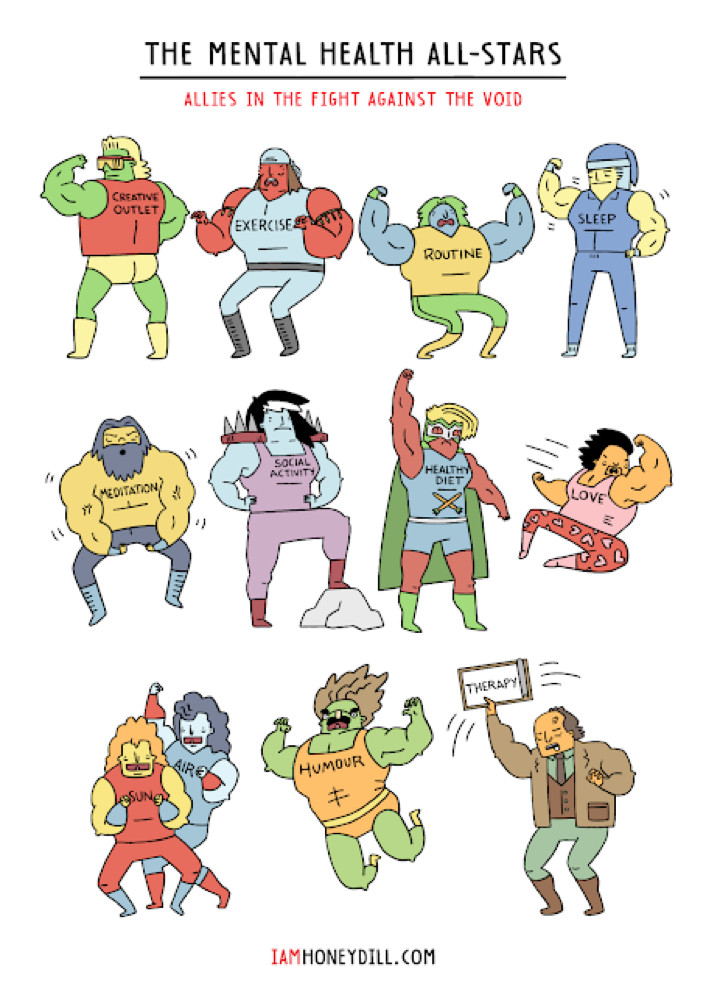
Before we discussed the first six of the Mental Health All-Stars. In this post, we'll continue exploring these areas of self-care that give us the armor to stand up against depression and anxiety.
7. Healthy Diet
Nutrition plays SUCH an important role in mental health and wellness. In many ways, the food you eat influences the function of your brain and mood. There is lots of research showing that a healthy diet is just as important to mental health as it is to physical health. A low-quality diet that's high in refined sugars can really impact depression and anxiety. To reap the most benefits of nutrition for mental health, focus on a balanced diet that is nutrient-dense. Research shows that diets high in these vitamins pack the biggest mental health punch: B Vitamins, Iron, Zinc, and Omega-3s. If you feel you may be nutrient deficient, be sure to have a chat with your primary care doctor! It's helpful to approach mental health care from all angles. Don't underestimate the importance of nutrition and a healthy diet when considering your mental health care.
8. Love
I love love! Love literally creates a chemical reaction in our brain that releases oxytocin, which is a feel-good hormone that lifts our mood and creates a feeling of attachment. Loving and stable relationships can create a strong emotional support system for those suffering with depression and anxiety. Love comes in all forms. We have love for our family, our friends, our partners, and our pets. Making it a point to create love in your life, in any form, is essential to emotional well-being. Spending time with people with whom we have quality, loving relationships can help us feel more secure and not so alone. However, depression and anxiety have a way of making us isolate. It's important to take things little by little--cuddle a pet, text a friend, or listen to a song that reminds you of your partner. Nurturing those healthy relationships and bonds reminds us of the loving supports that we have in our lives, and sets our brains up for mood elevations.
9. Sun and Air
It's amazing what a little time in nature can do for our mental health! Walking has been shown to be effective in reducing anxiety and depression. Evidence also points to nature being an added benefit to those results! Being in the sun and getting fresh air helps to calm our minds, leading to psychical changes in blood pressure and heart rate. You don't have to go hiking or mountain biking to get these health benefits. Just spend some time outdoors for a few minutes each day to reap the benefits. Bonus points if you can add a little meditation into your nature time.
10. Humor
Laughter helps. When you can share a good joke with a friend, watch a funny movie, or find a hilarious meme, life feels just a little lighter, if only for a moment. Laughter releases endorphins in our brains and eases distressing emotions. One of my favorite self-care activities is to watch funny YouTube videos. It helps me relax and makes me laugh! Find something that makes you smile and adds a little humor to your life. It won't make you "un-depressed," but it will help to lighten your day, just a little bit.
11. Therapy
If you're struggling with mental health concerns--be it depression, anxiety, issues with past trauma, relationship concerns, insecurities, low self-esteem, addiction, etc, therapy helps. It's so powerful to share your story with a trained, trusted professional. In therapy, you'll be given a safe space to explore your thoughts and feelings, and will be given the tools you need to be successful in reaching your goals for your mental health. Therapy can be one of the most powerful tools at your disposal to overcome challenges and grow from your experiences. It's important to make sure you have a good fit with the therapist you're working with. Research shows that one of the biggest factors in determining the success of therapy is the therapeutic relationship. How will you know if you've found a good fit? You'll know if you feel comfortable and safe with your therapist, and feel that you can trust them to give you open and honest feedback regarding your concerns. You'll feel understood and validated. You might not always like what they say (sometimes therapists say things that are not easy for us to hear), but you'll always feel respected and like your goals and needs are at the heart of the session. If you have questions about what therapy is like, visit my FAQ page: FAQ.
I hope this list has been helpful in exploring some tools to care for yourself as you bravely do great things despite your depression and anxiety. It's important to remember that none of these things will be a complete and total answer all by themselves. Your mental health concerns are real and valid, and deserve ongoing treatment and care. However, these tools are absolutely necessary to help you in your fight to win the battle. You've got this. And you're strong.
Take good care of yourself.
Written by Kayla Renteria, LPCC - mental health counselor with Renteria Counseling in Louisville, KY
I work with children, adolescents, and adults with a variety of presenting concerns. Many of my clients come to me with concerns related to anxiety, depression, relationship issues, and past trauma. My experience as a therapist has provided me the opportunity to work alongside clients from many different walks of life. My philosophy on treatment is to empower my clients through a trusting relationship, compassion for their situation, understanding that they are doing the best they can with what they have, and a good measure of humor to keep things real. I specialize in treating trauma, depression, and anxiety.
I am also trained in EMDR, a highly effective and efficient treatment modality for trauma and mood disorders. I know how uncomfortable it can be to address painful moments in the past and present. I am honored to walk alongside my clients as we work to heal the past and move forward in a healthy way.
My educational and professional experiences have provided me with the expertise to guide you, utilizing evidence-based treatment principles and an unwavering sense of compassion. I would love the opportunity to talk with you about how I can help you. When you're ready, give me a call or use this link to schedule “.
The mental health and wellness professionals that practice out of b.mindful Louisville are skilled in what they do. Each specializing in their own area and caring for their clients in their own unique way.
If you need help finding the best human helper to meet your specific needs, email us for one-on-one assistance.
*The information and resources contained on this website are for informational purposes only and are not intended to assess, diagnose, or treat any medical and/or mental health disease or condition. The use of this website does not imply nor establish any type of therapist-client relationship. Furthermore, the information obtained from this site should not be considered a substitute for a thorough medical and/or mental health evaluation by an appropriately credentialed and licensed professional.

11 ways to fight depression and anxiety (part 1)
It's difficult to find that inner-strength when depression and anxiety have their grip. Normal activities feel so much more exhausting, scary, or impossible.
I borrowed this super cute comic from iamhoneydill.com, which is an awesome webcomic if you haven't checked it out. I love this comic, and share it frequently with my clients. Depression and anxiety can be so debilitating. It sucks our energy and our motivation, it tells us we can't when we want to believe we can, and it can make us feel so, so small.
It's difficult to find that inner-strength when depression and anxiety have their grip. Normal activities feel so much more exhausting, scary, or impossible.
I find that many of my clients feel empowered when they are able to access the ways in which they can take back control of their lives, even if it's in just a small area. In this blog post, we'll go over each of these "Mental Health All Stars" to explore how you can better access tools to fight back in the battle with depression and anxiety. We'll start with half of the All Stars this week. Stay tuned for the next post to learn about the second half!
1. Creative Outlet
"Creativity takes courage" - Henri Matisse
Creativity has a way of propelling emotions and experiences forward that are too difficult to be expressed in words. Research shows that creative outlets, like painting, drawing, music, and writing, help people manage their negative emotions in a productive way. If you're an artist, you'll know what I'm talking about--there's something very special about expressing yourself creatively that just can't be done with words. If you've never tried your hand at a creative outlet, or feel like you won't be any good, remember that healing through creativity is not about the output, it's about the process. Whatever brush strokes you take or chord progression you form doesn't really matter in the end. The important part is the creation of it. The expression of what can't be said. The emotional process. Give it a try! Buy a cheap canvas and some acrylic paints at Target, turn on some music, and see what happens. You could also try a musical instrument, a drawing pad, modeling clay, or an adult coloring book if that's more your style. There are endless ways to be creative and none of them have to be fancy!
2. Exercise
Yes. Exercise is on this list. I know. I dread it, too. Some of you may love it, though, and good for you! Exercise releases chemicals like endorphins and serotonin that improve your mood. Making exercise a habit in your day to day life can ensure that you're brain is juicing out those feel good chemicals on the reg. Fear not: you don't have to run a marathon in order to get the mental health benefits of exercise. Studies show that the sweet spot is about 30 minutes of exercise, 3-5x per week. That's doable, right? If you're new to exercise, take it slow: try some yoga, or take Spot for a stroll in the park. Slowly build yourself up to a routine that works for you. Speaking of routine..
3. Routine
We all like to know what to expect. Especially for those with anxiety, having a routine in place can help to reduce stress levels. It can be incredibly overwhelming to feel like we have a million things to do, and a ton of stuff running through our mind all at once. Having a routine helps us to organize ourselves a bit, and to prioritize our lives. It can feel like a relief to know what's coming and not feel like everything is happening all at once. Routine gives us a sense of control. In addition to reducing our stress, routines also help us hold ourselves accountable for building healthy habits. When we commit to a routine, we commit to taking certain actions daily for the betterment of our health. Like all things, start out slow. Choose one healthy habit that you'd like to cultivate in your life. Maybe you want to drink more green tea (hello great start to your day!), or perhaps you want to journal each night before bed. Commit to something that's doable for you, and slowly build that habit up. Once you've mastered that habit, add in a new habit. Maybe something a bit more challenging, but not unattainable. Think about the things you want to accomplish each day, and a goal that will help you get there. You've got this.
4. Sleep
Good sleep hygiene is sooooo important for mental health. I can't tell you how many clients I work with--adolescents and adults--who don't get enough sleep every night. You know the feeling, don't you? Groggy, irritable, barely alive. Your only salvation is a Venti Americano! I know that feeling, too, and it makes life really hard. Lack of sleep makes us more vulnerable to anxiety and stress, and negatively impacts our mood. It works both ways too: when we're stressed and anxious, falling asleep is hard! To practice good sleep hygiene, try the following:
- Limit your screen time at bedtime. Try putting your phone on your dresser on the other side of the room, so you're not tempted. At the very least, make sure you're dimming your screen if you can't seem to part with it.
-Have some tea, take a bath...get cozy! Try priming yourself for bedtime by making yourself as comfortable as possible
-Try some relaxation exercises. Deep breathing, yoga, or visual imagery are all great methods to try as you lie in bed waiting for the ZZZZs to come.
-If you don't fall asleep, get up. Don't lie in bed awake. That makes falling asleep that much harder. Instead, get up. Read a book, watch a show, clean the kitchen, and wait to feel tired. Once you feel that sleepiness coming on, head back to bed.
Sleep doesn't always come easy, but with these tips, you'll be snoozing sooner!
5. Meditation
Have you ever tried meditation? It's definitely a buzz word these days, and for good reason! Meditation is a practice to obtain a mental clarity and a mindful state. It's a skill--so it takes practice. But even in the beginning, you'll find that the benefits of meditation are huge. Research shows that meditation actually changes your brain and the way your mind responds to stress and anxiety. For some people, it can work as effectively as medication (according to this study )! Like all things in this list, take it slow to start out (remember our routine building discussion?). The experts say that meditation works best when we practice it consistently--that means every day. Start out with just five minutes a day, first thing in the morning. You'll be amazed at how good it feels to set yourself up for a good day in this way. I really love the meditation apps out there. Two of my faves are Headspace and the Calm app. Both of these have premium subscriptions, but the free ones offer access to great beginner sessions to introduce you to the practice of meditation. Also, there are TONS of free meditations on YouTube. Can't sleep? Search "meditation for sleep." Feeling burnt out at work? Search "meditation for work." Have only 3 minutes? Try "3 minute meditation." Literally anything can be found with the magic of YouTube. Give it a shot, I promise you'll find some benefit from the practice. And hang in there--like any skill, this one takes time to learn. But with practice, you'll find it becomes easier and easier to center yourself.
6. Social Activity
Socialization is so key to our mental health! It can be tough, though, when depression and anxiety hits. When we get a text to come hang out, but we just feel like staying in bed. Or if we so wish that we'd get a text to come hang out, but our phone stays silent. Either one of those really hurts. It can be hard to put ourselves out there. If you struggle with finding the mental and emotional energy to make socialization a regular part of your life, try making a deal with yourself. You'll hang out for 30 minutes, or an hour. If you feel like going home after that, no big deal. Let yourself off the hook. Sometimes you might find that you're feeling better when you're out with other people. Other times you might feel drained and ready to leave. Either way is perfectly okay--you have to meet yourself where you are. Surround yourself with people who understand, and don't let anyone make you feel bad for taking care of yourself. If you're struggling with loneliness and meeting people to hang out with, there are a few options. It can be scary to put yourself out there, but there are a lot of supportive outlets for people looking to connect. Joining a support group is a great way to find people who are dealing with similar concerns. Often, my clients find that these groups allow them to feel understood, like someone else really gets it. Here in Louisville and Southern Indiana, we have the Depression and Bipolar Support Alliance, which is a great group for people with anxiety and depression seeking help from folks who understand. In addition to support groups, there's also this really cool website called Meetup, where you can connect with people in your age group that share a common interest with you. There are plenty to choose from--book clubs, rock climbing meetups, groups for people just moving to the area. Finding healthy ways to connect with others is important to our wellbeing. We're social creatures, afterall. Having a healthy support system and feeling like we belong improves our mood. Taking action is one way to be an advocate for our own metal health.
That's all for today! Tune back in for Part Two of this blog post, where we'll explore the remainder of our friends the Mental Health All Stars!
Written by Kayla Renteria, LPCC - mental health counselor with Renteria Counseling in Louisville, KY
I work with children, adolescents, and adults with a variety of presenting concerns. Many of my clients come to me with concerns related to anxiety, depression, relationship issues, and past trauma. My experience as a therapist has provided me the opportunity to work alongside clients from many different walks of life. My philosophy on treatment is to empower my clients through a trusting relationship, compassion for their situation, understanding that they are doing the best they can with what they have, and a good measure of humor to keep things real. I specialize in treating trauma, depression, and anxiety.
I am also trained in EMDR, a highly effective and efficient treatment modality for trauma and mood disorders. I know how uncomfortable it can be to address painful moments in the past and present. I am honored to walk alongside my clients as we work to heal the past and move forward in a healthy way.
My educational and professional experiences have provided me with the expertise to guide you, utilizing evidence-based treatment principles and an unwavering sense of compassion. I would love the opportunity to talk with you about how I can help you. When you're ready, give me a call or use this link to schedule “.
The mental health and wellness professionals that practice out of b.mindful Louisville are skilled in what they do. Each specializing in their own area and caring for their clients in their own unique way.
If you need help finding the best human helper to meet your specific needs, email us for one-on-one assistance.
*The information and resources contained on this website are for informational purposes only and are not intended to assess, diagnose, or treat any medical and/or mental health disease or condition. The use of this website does not imply nor establish any type of therapist-client relationship. Furthermore, the information obtained from this site should not be considered a substitute for a thorough medical and/or mental health evaluation by an appropriately credentialed and licensed professional.